

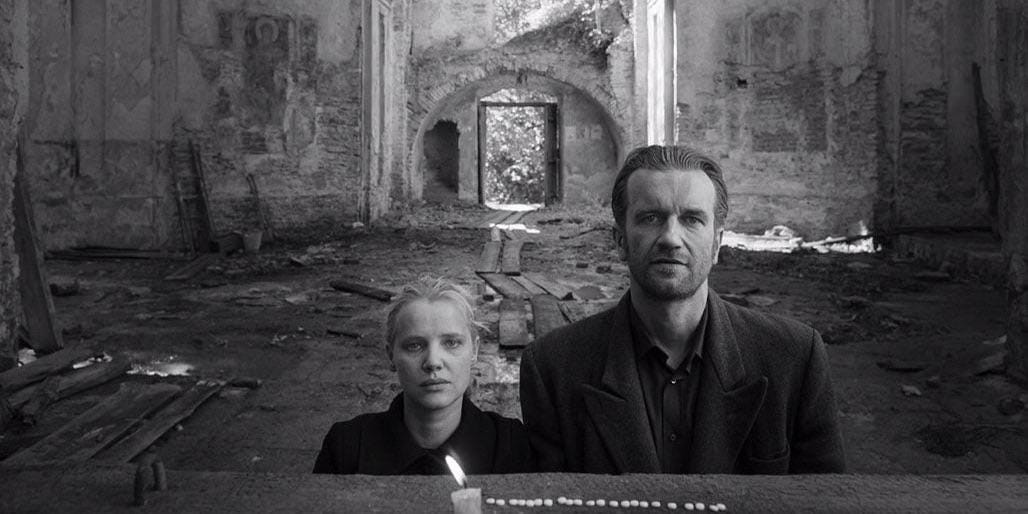
In 1944, the Hungarian poet Ágnes Nemes-Nagy concluded in a poem about her husband: “I love you, you love me. How hopeless!”
I’ve got around to finally watching Cold War, Pawlikowski’s middle installment in what’s shaping up to be a black and white trilogy that started with the Oscar-winning Ida and now ends with the Thomas Mann road movie Fatherland, currently playing in cinemas. (Find my review of Fatherland here.) I was worried that watching the “trilogy” non-chronologically would ruin it for me, but the truth is Cold War really is the climax, the synthesis; I was right to leave it for last. What in Ida was an entry into shame-shrouded personal history and startling private revelation, in Fatherland ends up as abstract, international, collective legacy. Where the annals and the intimate seamlessly and violently intersect is in Cold War, an almost unbearably revealing film about the terrible deadlock that love is — whether history happens to be in your way in a given era or not.
It’s in our lovers’ way alright. Take two people instantly attracted to and never possibly with each other. The singer Zula and the pianist Wiktor are based on the director’s own parents. They meet in postwar rural devastation. She lies a little, he abuses his post a lot. They will never fully leave that time and place behind. Is that nostalgia? Masochism? Actual disillusionment with the glib temptations of the West they eventually get a chance to taste and reject? Or is it vain denial by two people who prefer to embellish their memories of a past purity they never seem able to rebuild anywhere else in the world together? This being a movie with real teeth you will be reminded for immigrants a return home is no longer an option either — of course when they’re Communist dissidents, that emotional anguish is paired with labor camps and torture too.
Pleasures, even in this predicament, abound. It’s hurried, worried, muddy, and true. Pawlikowski shows you the devilish depths of this love that demands life, always. Love amid the monsters of history, exile, prison, sexual coercion, cultural propaganda, even murder. Then love amid the globalist, pointless, consumptive frivolity they come to find abroad. At home, there are the people who understand them too well — there’s nowhere to hide. In Paris, nobody will ever understand them. There’s no way to show.
Cold War achieves its feats without handing you condescending answers about whether the woman (a loyal, passionate, attention-seeking entertainer) and the man (an ambitious, principled, hardworking composer) could ever build a proper relationship in calmer circumstances. There is no way to tell because there never is.
Are horrific conditions merely distracting this couple from facing their far more commonplace romantic problems which would be just as destructive for their love? Do they have any problems in the first place only because of the antagonistic world that wants to smother them? Would they even be so hung up on each other were there no difficult — but at least interesting — obstacles to surmount?
We see them fall for each other within seconds. They try to have each other. They try to own each other. They try to use each other. Yes, they endanger each other. Yes, they save each other. They cannot live without each other — nor can they die.
When the Hungarian quasi-dictator Viktor Orbán once quoted Lőrinc Szabó’s abuse-adjacent love poem ‘Semmiért egészen’ (Everything for Nothing), the local literary world perked its heavy head up: it reminded them and everyone that every love affair is a dictatorship of some kind, maybe all personal relationships are. Rights begin where love ends, as per Hegel. You can have liberal democracy but never in the bedroom. Perhaps the best way to make a movie about a dictatorship is to tell a love story. And the best way to show the realities of love is through political tyranny.
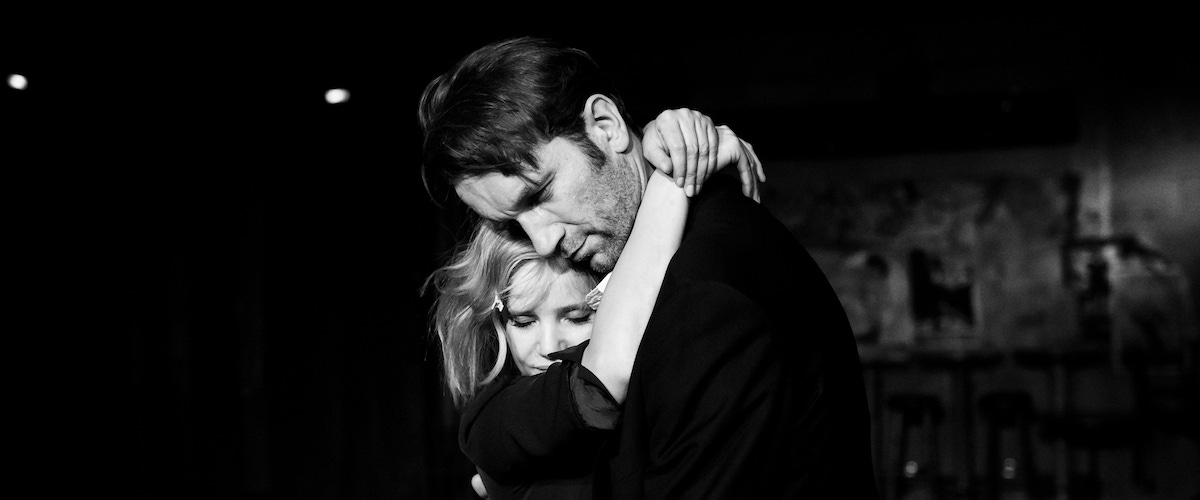
In Pawlikowski’s trilogy, everything is black and white except one’s morals. Love and subjugation seem to annihilate the moral concept, as the moralizing world is busy annihilating them. Look at the couple in love and see the ultimate expression of choice, of individuality, of man’s unalienable choice to give up individuality. Whether it’s collectivism or consumerism that’s after you, the one way you can save your soul — even if you shall lose everything else — is by choosing.
If Ida contained nods to Rossellini and Menzel, and Fatherland paid tribute to Bergman, then Cold War feels as split in its inspirations as this couple, as midcentury Europe, as the ethical lover herself. She is all Tarkovsky — the mother in Mirror stares back at us across Polish snow and ice. And he is right out of Fellini — the glam house parties in La Dolce Vita presented the same artistic tradeoffs, the same deathwish. As on love, both collectivism and capitalism seem intent to prey on creative talent, always, everywhere. Can the artist ever be free? Can the lover? (Do they want to?)
The performing arts never change. Entertainers must schmooze with Stalin or French record producers alike. The stakes might be very different, but the requirements are not, as Zula and Wiktor must realize. They try to deal with it the best they can. For a little while, they can. Love also never changes. Isn’t entertainment just wanting to be loved?
In Pawlikowski’s colorless, high-contrast world, the demons of history and choice paste dark shadows on stage-lit faces — musicians and lovers, partygoers and border guards, the children, the frescoes — like tall slabs towering unstably over everything but the fleeting. Whatever remains? The Church, the prewar, ancient certainty. An attempt at Girardian transfiguration. There’s the impossible we cherish. The drinking and the slush. Those that seek to enslave us. Those we cannot let go. The hard-lined cheeks, the mangled hands, our free hearts.
As befits this trilogy, I was again moved by how historically accurate Cold War was, how many familiar details it revived, the things I saw or heard or read about before but which you never see on the screen. Not today. Eyes, foods, lies, rules. The times and the mores. Tragedies that still might be happening to someone somewhere and tragedies you can’t even imagine anymore. (Ida had such sly details too — anecdotes and archeology, what we owe to those generations is to testify.)
Within these precisely painted constraints and determinisms — real historical conditions that deserve to survive not only textbook-dry but as living and breathing settings of human narrative — the wild-minded lovers who sired the film’s director move around and rebel and dance and sing, tearing at their chains with a vehemence only those unaware what they’re dealing with will stay in place for another 40 years could summon. It is all very stylized — the cinematography, the lighting, the editing, how the story jumps ahead — and all very, extremely real. Fans of Kundera will adore this film. Fans of the anodyne, misleading The Lives of Others will miss from it the fictive idyll, the black and white, childish morality, the easy ways out.
I believe Cold War is the crowning jewel of Pawlikowski’s great black and white trilogy of men and women versus inhumane history. Some win, some lose, but most people, always, find themselves in the middle, struggling with and creating impossible bargains. Go watch it. Expect a tough, sexy, self-honest masterpiece. You will leave this movie different and more you.
9/10.
The real parents -- also Zula and Wiktor: https://www.hollywoodreporter.com/news/general-news/making-cold-war-how-directors-disaster-parents-became-a-love-story-1157535/