So he new Paweł Pawlikowski movie Fatherland has arrived. I watched it last night, and I promised you a review. Here it is:
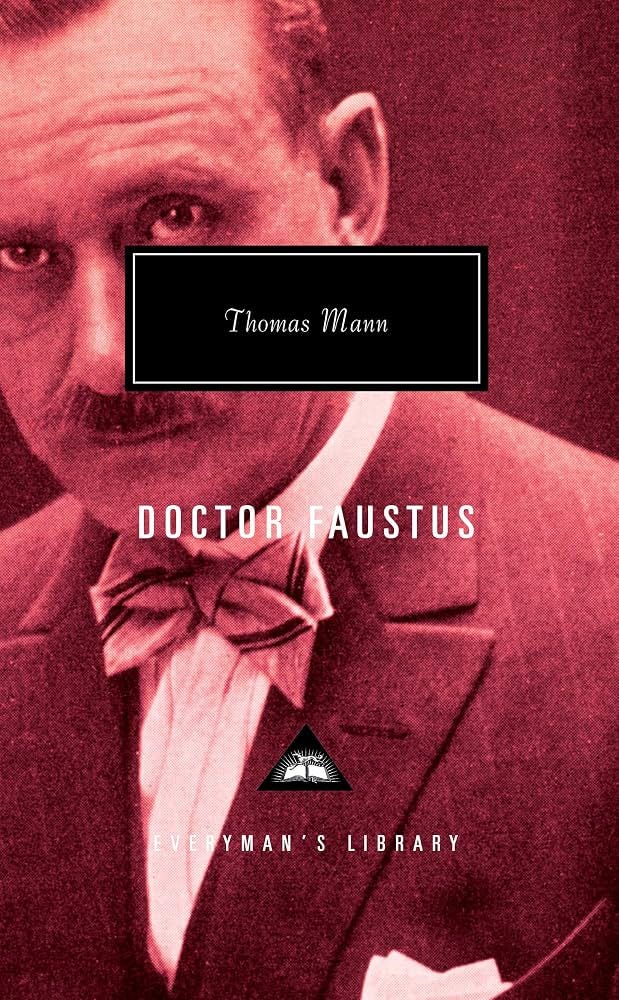
1. Overall, of course I am happy there is a movie about Thomas Mann, and his complicated life and literature. He was a giant of European letters, an emblem of a historical dilemma, and largely overlooked by the movie business (for understandable reasons).
2. The film is well-written, and like Pawlikowski’s masterpiece Ida, a parable of a whole realm of problems as condensed to a short period. Good. Thomas Mann was the great bourgeois writer writing big heavy difficult awkward beautiful books, then the Nazis stripped him of his citizenship, then he went into exile, then he spent the rest of his life advocating against tyranny. The Americans thought he was a commie. All the while his family was a Freudian mess filled with rivalry, drugs, excess, and self-hate, a true show business family. Behind his back, his children called him Z. - Zauberer, magician. Not kindly.
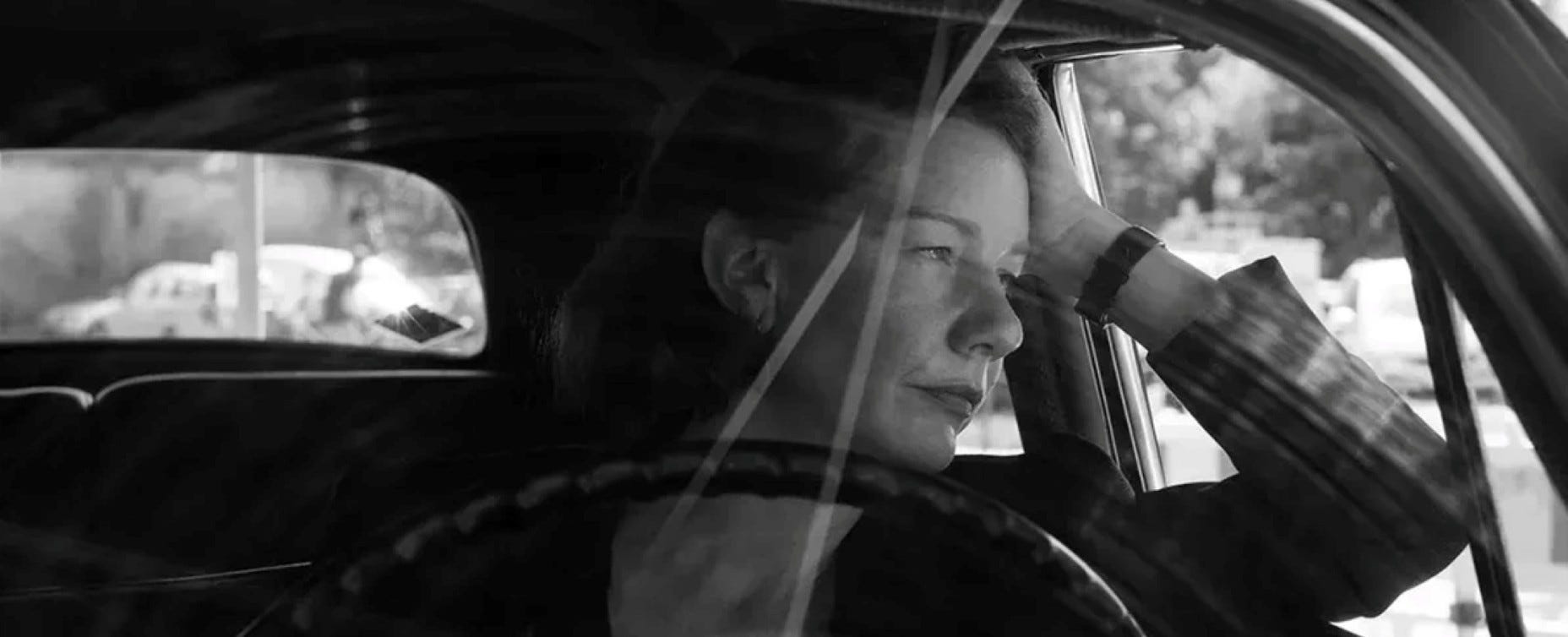
3. As in Ida and Cold War, Fatherland is black and white (filmed in color) and is strikingly well-designed, a time travel. Not as perfect as Haneke’s The White Ribbon, but nearly. You will see things in this movie too that I only saw in documentaries of the era -- Frankfurt am Main bombed out and in ruins, for example, and people just living on life amid the rubble. That is how it was, yes. The faces, the extras, the glances ---- this is as close as we can get to how it felt to be a person back then. No retroactive revision, or at least not deliberately. Thank you.
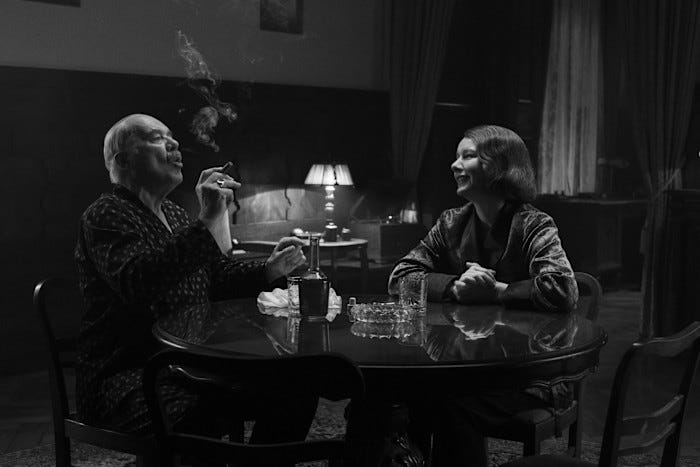
4. As is now Pawlikowski’s trademark, we also get beautiful still-lives of symmetrical art deco hotel stairs and outdoor dinners, choirs and auditoriums -- a kind of depressive-socialist Wes Anderson world that is an aesthetic pleasure for all and a nostalgic throwback to people from that region. Time travel seems to require a lot of realism, but in fact that is only partly so. We also want these stylized moments in between, a staginess that creates the distance for us to be able to bear it.
5. But the cinematography here broke its own spell several times for me, during the exterior scenes that featured movement - walking people, moving cars. Very strange! The static black-and-white compositions had the usual striking, filmic quality (shot on ARRI Alexa 35!) but the motion rendering in some of these exteriors with people and vehicles moving felt strangely video-like. Like watching YouTube? It pulled me out of the world Łukasz Żal, the DP, had so carefully created.
6. This was not the only reason for why watching Fatherland which had been called “flawless” was a mixed experience for me. I was seeing it at Film at Lincoln Center in NYC with a friend from Central Europe with whom we studied continental art philosophy, growing up on and with Thomas Mann at home and in school -- we are *the* audience for this. And even for us, it was amazing just how context-demanding this movie is! You have to know everything about Thomas Mann’s life, work, and family to be able to understand the story, which is presented in snapshots full of subtext and “fill in the blanks”.
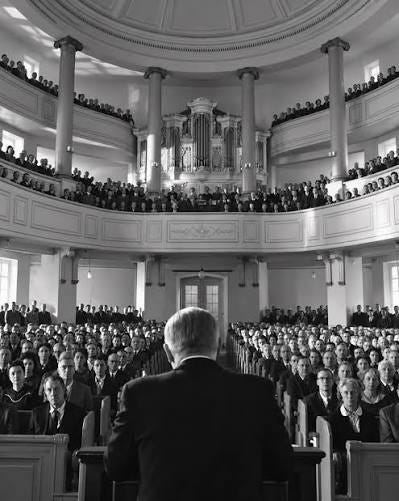
The movie’s great central dilemma -- whether it was his father’s overbearing fame, his own mental health issues and drug addiction, or the Nazis who banned his own books that killed Thomas Mann’s son Klaus -- would have either deserved so much more nuanced treatment, or it should not have been made into the movie’s central dilemma.
Interested in Thomas Mann’s diaries? The 1918-1939 edition is great, consider reading it.
I have no idea how audiences will able to understand let alone be truly moved by what is going on in Fatherland -- the father’s denials, the son’s suicide, the mutual historical and personal betrayals. The image of the divided Germany is powerful, but do people today even know it was so, and how it was, who died, who left, why, and who stayed and went unpunished? Do they know what those East/West checkpoints are, why military generals talking about Hegel is funny, why an army that razored and raped your country staying on and singing you jolly folk songs during state lunches is haunting?
7. Pawlikowski hadn’t made a movie since 2018. This one had about 30 producers and co-producers. My friend and I were laughing they must have all given him 5 euros each? The movie is economical, shot in hotels, on the road, etc. What took so long? Why was so much support needed? Why did he make this movie of all available options? And why was it apparently so hard for him? And then the movie itself is less than 90 minutes -- it says almost everything it wants to say in the first act. Then runs out of things to say. After 8 years ... What happened? I’d love to know.
8. The movie is of course full of Faust -- via Goethe whose anniversary Thomas Mann travels back to postwar Germany for in the story. Via Klaus Mann whose Mephisto novella got him in so much trouble. And through Mann as well, a bit on the nose, with his novel Doktor Faustus -- and with, we are made to think, his character and moral dilemmas. But in the end I felt it was Erika, his long-suffering daughter, who makes the pact with the darkness. Mann, the boss, the one being always visible and served and celebrated, always gets to stay in the light.
And of course the movie is also nodding to Bergman -- the midcentury warlike hotels, the subdued family members, and finally the emotional connection that is only possible to Bach.
7 our of 10 starts for me. Good but sadly not great. I have felt like this after some of Mann’s books too. But I don’t think here it was on purpose.
As we walked out we said: “We always almost got bored but the acting and the faces are impossible to look away from.”