
Like in a grand historical novel or a game of historical strategy, America’s new high culture has three ancestors:
🦅 The Ivy League — seminars, discussion groups, late-night extracurriculars
🏛️ European State Culture — art openings, idea festivals, free talks, book events
👾 Shanghai Cyber Art — screenings, exhibitions, art debates, internet-first art
Our current cultural Renaissance may appear “sudden” to you, but what you are witnessing increasing every day all comes from one of these great traditions of public culture — or some combination.

Nothing comes from nothing. Innovation is iteration until breakthrough. The melting pots of the West — London, New York, San Francisco, Los Angeles — all boost and rebuild something that has long existed.
So what is going on?
“We are hosting a salon for our founders.” “What is taste in the time of AI?” “We need new aesthetics.” “What is the future of the humanities…?”
Calls such as these abound on the timeline. Clearly, people want to spend more time with each other. Clearly, companies want to brand themselves as non-inhumane. Clearly, people want to schmooze and date. Clearly, free food is not a bad offer... But — most importantly — we now have a massive American cohort, mostly in the big cities but thanks to remote work everywhere, really — who are educated and well-read, and who have very little active access to participatory culture.
If somebody is both ambitious and smart and has a lot of great things to say, it is only natural they will seek out opportunities to build a rich life of the mind, and they will try to do this so it includes both solitary contemplation and communal enjoyment.
And voilà, a strange new cultural institution like my company Interintellect can exist and list incredible conversations for $30 every single day. This is why your inbox is full of invitations to Chinese-American pop art installations in San Francisco or in London the mercantilist re-evaluation of pastries in Proust. Where there is a need, entrepreneurial knowledge will become useful.
And this knowledge in today’s America comes from three very distinct places.

The National Hunger
Markets being able to work as they do, when people, independently from each other, notice something missing, they often find the motivation to fix it. When educated individuals of some means find themselves living in close proximity to each other but that their opportunities to gather and enjoy and create culture together are scarce, you know something new will arise. The people looking for better cultural institutions — stable stewards and resources of art, ideas, and community — will either leave … or build some.
America, a place where everything always seems to happen “from scratch”, is a marvelous place for this constant renewal. In America, if you want culture, you need to make it or at least to pay for it. If you want knowledge, you must seek it out. If you want to find community, you need to build it or find someone who is. That we see so many new cultural institutions blooming all over America today should not come as a surprise. Having little of x, but a lot of time and resources to build x, is great for innovation!
It is very interesting how the three “mothers” of new American High Culture — university discussion groups, European state culture, and Asian art scenes — each find their missions perfectly accomplished in public America. Here, what would be gated and exclusionary on an Ivy League campus must be made open. What would be state sanctioned, politicized, and risk-averse in Europe must be appealing and commercially viable. And what would need to navigate treacherous censorship in China can count on constitutional protections of free expression.
I don’t know if this is because of COVID, because of the maturation of Millennial business and businesspeople, or because of some general social media and new media fatigue, but I have never seen these three strands as active and fruitful as they are today since I started Interintellect ten years ago.
In fact, I feel like Interintellect itself happened so early because of a simple historical coincidence. In 2016, I found myself newly arrived in London, suddenly broke and alone, my personal life gone, my home country falling apart politically which made return impossible; the UK had just voted for Brexit, Trump had just been elected, and eventually Zuckerberg was dragged in front of Congress making everybody uber-paranoid about the internet.
The kind of intellectual life I grew up in and considered my birthright was both out of reach personally and disappearing collectively. Where would I gather, learn, read, befriend, discuss, challenge, and tend? It seemed impossible. Both my personal and collective history had imploded, and so — isn’t this the American Dream? — I had to go rethink everything and rebuild from zero.
In a strange way, the cultural institution Interintellect was my personal and public reinvention of the culture I think everybody needs. Ten years later, it looks like I was spot on.
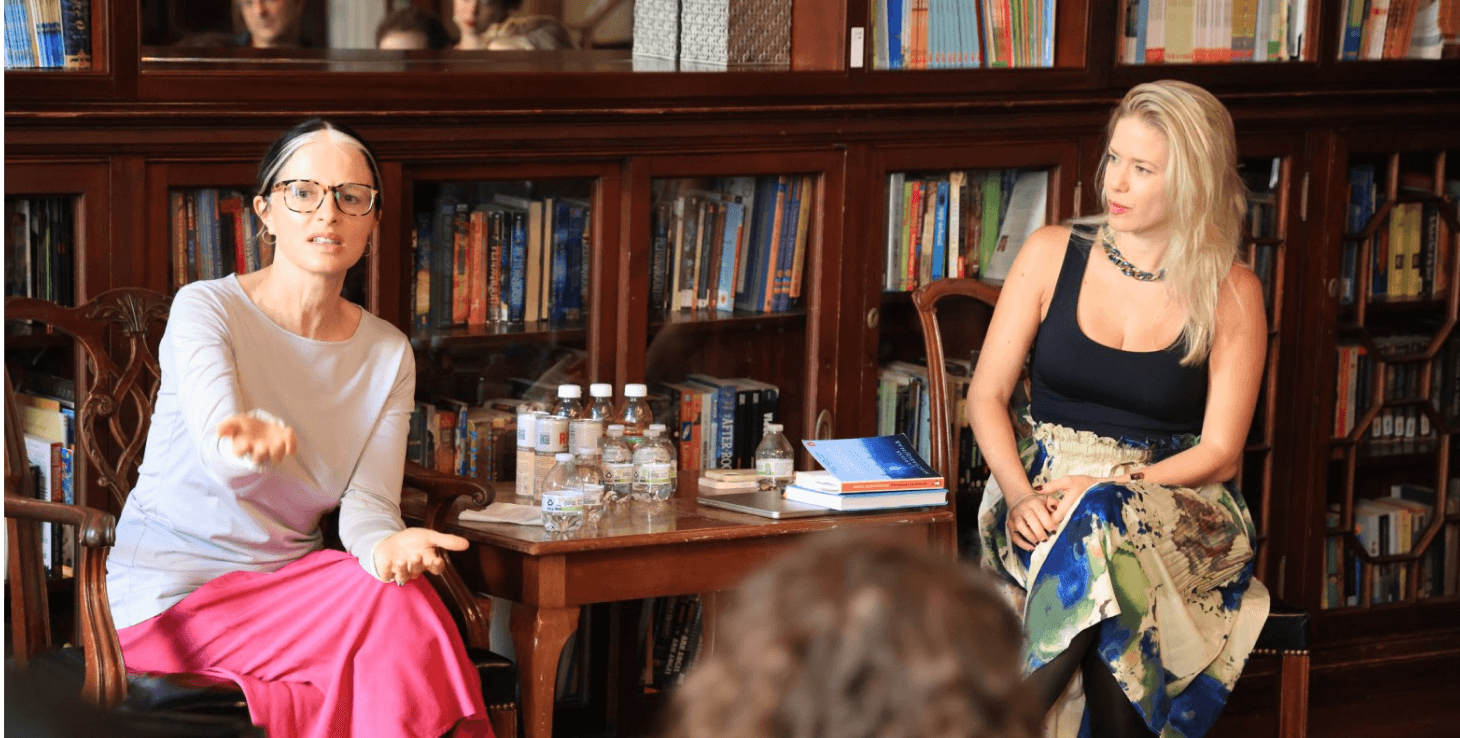
And so I was shocked into my insights a little bit earlier, and built my cultural engine among the first. Today, my industry is catching up with a big wave of salons and magazines, book clubs and gallery events. The dinner party may be declining in America but not in the centers of cultural pioneering — a great sign of what is soon coming to everyone. I am here for it all, and more.
When there is a lot of something, it is of course worthwhile to be discerning. The first two years of Trump vol2 taught us about hidden Left/Right agendas, and how some of “culture” is really just people trying to sell you stuff. There is a reason why Lindy cultural organizations like TED and Interintellect have such strong rules against political, commercial, or religious missionary work. Good cultural institutions know they have to provide what is missing — ideas, connection, a type of intellectual or even moral purity. We’re well aware if you want to be preached to or sold something there are plenty of other places where you can go. We give you what you can’t get anywhere else.
As you’re exploring new cultural movements, be wide in your sweep but selective in your commitments. Some will indeed be l’art pour l’art — meaning they are what they seem, and seek only to further culture. But some will advance more hidden intentions, like pushing political ideologies on you or helping the hiring or branding efforts of companies. Culture is people, and people are of course messy. But it is useful to give a new cultural program a second glance before associating with it, just so you know what you’re getting yourself into.
Understanding the three “mothers” is a great place to start in your decision-making process: a university study group opening to the public, the European tradition arriving to entrepreneurial America, or uncensored art from other continents can be quite clean entry points into this new cultural whirlwind.
I personally always ask: Is this organization generous?
The grand cultural institutions of the previous century were generous. The New York Public Library has always welcomed everyone. Penguin put great books in every pocket for the price of a pack of cigarettes. Les Éditions de Minuit was founded in secret under the Nazi occupation so French writers could publish free of censorship, and it gave the world Samuel Beckett. London’s National Theatre still sells £10 tickets to anyone aged 16–25. The list goes on.
If any new movement aspires to be a cultural institution, it too must be generous — and generative.
Gatekeep-y cliques, fictional rankings based on gender and sycophancy, or Girardian social massacres are not unheard of around us. They should be your big red flags to avoid. To some, culture seems like an easy path to power — but vanity projects or status-and-survival dramas have little to do with either “public” or “culture”, for the simple reason that they do not in any way benefit the participants. I’ve seen “cultural” circles that were set up around leaders’ random needs, and if participants wished to leave with any value, they were basically encouraged to fight it out among themselves. I was sad to have to watch. It had nothing to do with ideas, discovery, achievement, or merit. When I encounter these circles, I always find myself having been made to cook for everyone, and I always leave starving.
Remember that all “institutions” are about time — past continuity and future creation. All “culture” is cultivation — of what is under its care, of people who enter it, of ideas for a shared future. It is a process of gathering and growth. You should ask for nothing less as a participant and aspire to nothing less as a builder yourself.
Traditionally, salons were held in the private quarters of the noble wife, the wealthy and knowledgeable spouse who, for a good chunk of history, could hold no formal power. This enabled the salonnière to neutrally preside over whatever conversation. For the husband — with his army, post, real estate, money and suffrage — such unbiased hosting would have been impossible. What side he was on was known to all. It was his spouse who could truly be secular.
The distinction stands today. Maybe even more so. Whoever seeks to build a credible cultural movement must demonstrate her independence from the immediate pressures of power. Her openness of mind. Her warm welcoming of people without prejudice.
The generosity of spirit is not optional — it is the fuel this whole endeavor runs on.
I often think about Leonard Cohen’s great song Democracy. Building Interintellect, I am not indifferent to the transcendental ideal of “the holy places where the races meet”, both in the literal and in the figurative sense. But in that song, Cohen also warns about the “homicidal bitching / that goes down in every kitchen / to determine who will serve and who will eat”.
In a real institution, all parties are governed by the same rules. The lack of transparency and equality is detrimental to ongoing participation. A cultural institution should run on a clean deal between all parties and no one must be left unprotected or exploited. Sometimes, it still happens: I started early and this gave me some advantage; it also meant I saw an earlier generation of “new culture” which wasn’t very new at all. Old habits that in the 20th century marred business and academic practices for women and newcomers are still lurking here and there even in new American High Culture. Who gives and who takes should not be a struggle. That is antithetical to cultural innovation.
Even if in America everything is “from scratch”, thinking that reinventing aristocratic rigidity or royal-favor sliminess would somehow benefit culture is a mistake any European — or anyone who’s ever read Tocqueville — would recognize as ridiculous right away. Thou shalt not commit the cardinal sin against human collaboration — it is the foundation of all self-worth. It is the guarantee that we all are equal. Thou shalt not stunt people in their intellectual evolution. Thou shalt not take from people against their will or by deceiving them — or else they will not want to share with you again and there goes your Infinite Game.
A university group must gather each week: they are all determined to finish every chapter of the book. A European institute will have a new speaker every week: it holds itself responsible for being the space where people can discuss the world. An internet-art party is filled every weekend: some things can’t be said with words and still need an outlet. I am glad their time has come and culture-seekers will have more and more safe, stable, functioning cultural institutions to engage with.
A good cultural institution can save you from the bad loop (having to fight tooth and nail for basic inclusion or collaboration) and instead give you access to the good loop (time, space, means, and psychological comfort to cultivate ideas and preserve work for the future). Over war, peace. Over devouring the new, playing together. Values and norms that make those able to build cultural institutions actually want to dedicate their lives to doing this.
I often talk about how cultural institutions are doubly about time:
they preserve the values of the past
they guard present creativity for the future
Maybe there is a third layer: time tests whether a cultural institution is generous or not. Eventually, whether an organization can improve, whether participants can grow up in it, whether what was promised is fulfilled become clear.
Time tests things not just privately but collectively too. Some cynical or irresponsible behaviors become obsolete. This is partly market forces: more cultural institutions create more competition, meaning participants today have more choice in where to commit. The three “mothers” are busy at work.
And some of this is about the new cultural organizations themselves aging. Strong culture-building survives because it is generous and inclusive. Short-term money and status goals are fast fulfilled and forgotten. The will to build lasting culture lasts. Cultivation leads to flourishing — the harvests are shared over and over again with more and more people creating more and more harvests. No one has to cook for everyone. No one leaves starving.
What we learn by borrowing from older cultural traditions — universities, European institutes, cyber art galleries — is how to do this part well, here in America.
Three “Mothers” to Feed Us All
The three “mothers” bring ideals of longtermism and quality demands that can’t be bought with flattery. Follow these three paths to prominence and find yourself the cultural milieu that enriches, motivates, and nourishes you. It is a little bit different for everyone — what you like, what you need more of — even though the core needs and the fruits of this labor we all share.
In ancient texts, the trope of nourishment is a recurring one. “Pay heed to the providing of nourishment / And to what a man seeks / To fill his own mouth with.” in Ancient China. “He brought me to the banqueting house, and his banner over me was love” in the Ketuvim. “Whoever comes to me will never go hungry, and whoever believes in me will never be thirsty” in the Gospel of John. “Knowledge is the food of the soul,” warns Socrates in Protagoras.
This agricultural, motherly, table-laying quality is at the heart of culture — “hospitality”, “opening”, “taste” all speak to something primal about human needs. We cultivate lands — and we cultivate relationships and minds for a shared future.
You might be asking: Who is this European lady who so casually throws around “high” and “culture”, as if these weren’t very political and suspicious categories? And you would have a point. High culture is regularly misunderstood or mistrusted — no one wants snooty snobs parading around with their boring, incomprehensible works that no one cares about or is let anywhere near. But I can reassure you that parade is not high culture, because it is not culture. Culture is participatory. If you are excluded, if you are not allowed to “play with the other kids”, if your inclusion is forever deferred, that has nothing to do with anything cultural.
Picture it this way: when we say “high” we really are just talking about a high shelf, like when you have sticky-fingered toddlers in the house. As a society, we enjoy ephemeral, fast-changing pop culture: songs, memes, action movies. You consume them once and then move on with your life. But some things are just too good and we want to place them a little out of reach to keep them safe for later.
Remember: institutions provide buffers against market time. Their domain is protected by social commitment, expertise and capital so that things can be preserved for the long term and so that things that might not yet be viable can incubate. High culture is the stuff we want to save for later. It is for everyone, at every time. When a product of pop culture becomes high culture — a legendary movie, a jazz standard, an advertisement reworked into a painting — it leaves the rapid metabolism of consumer society and enters the process of preservation. You could visualize this as a change of vectors too: from the horizontal spread of popular entertainment these works are moved to the vertical journey into the future. When you die, you can be sure that Jane Austen and Jon Fosse will continue to be read and debated.
When people today want to gather, discuss, enjoy and connect — in cities around the West, on video calls, in group chats, and on Discord servers — they wish to enter a space that is both participatory and timeless. Real life is full of class, exclusion, physical distance, urgency, and oblivion. High culture doesn’t have these divisions — the same way as it does not have the limitations of mortality that you do.
Chopin was listened to 50 years ago and he will be listened to 50 years from now. His music is preserved for the rich and the poor, for the musically adept and the musically illiterate alike. A great conversation about Achebe, a roundtable about Christian morality, a seminar about artificial intelligence, or a poetry workshop, however new, should be just as open.
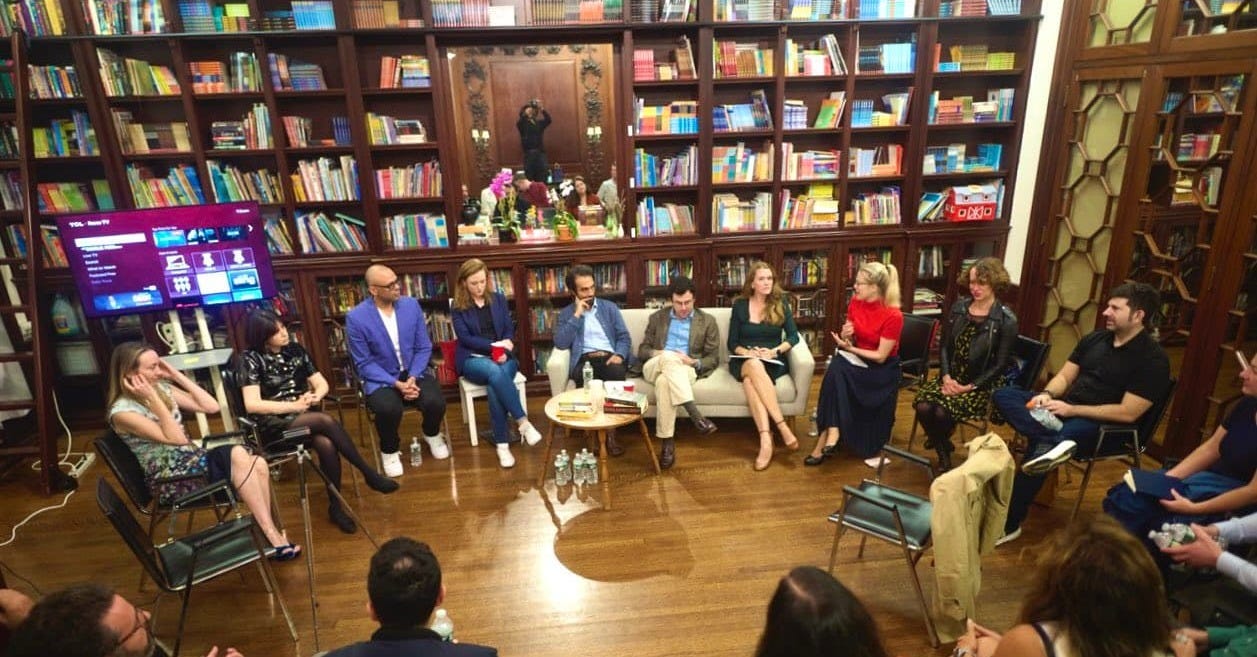
What the three “mothers” bring to new American High Culture is this combination of openness and stability they already had to perfect. They are older traditions from elsewhere — and like many great American (re)inventions, they arrive here in the hearts and minds of people who move into the big American cities or hang out on the internet.
The beauty about real, stable, participatory institutions is that they are transportable, exportable. Once you have figured out how a mutually beneficial equilibrium works you can rebuild it anywhere. And thus …
🦅 The Ivy League
… knows that good books and good conversation help put tribalism and rivalries aside, and that at study and discussion groups people can massage out their differences and sharpen their minds.
Great example to check out: Palladium
🏛️ European State Culture
… understands that cultivating a life of the mind is a desire and skill deep-seated in every individual, and that by simply providing avenues for people to explore this side of their selves the resulting flourishing benefits all.
Great example to check out: Interintellect
👾 Shanghai Cyber Art
… unlocked artforms and art discussions as a type of language through which matters of ethics, technology, and lifestyle can be explored in more nuance than through just verbal discourse.
Great example to check out: Tiat
When you engage with a cultural organization today that feels safe, fun, and accepting, you are engaging with a specific legacy or combination of these older, stable traditions of culture-building. I am very excited to see how they will continue to cross-pollinate and evolve here.
A Seat at the Table
In Ancient Rome — a stratified, tradition-bound society — patrons were supposed to feed their “clients” and in exchange could expect loyalty. The great cultural institutions of today’s establishment, from the University of Oxford to the Metropolitan Opera to Centre Pompidou, seek to provide similar nourishment within clear, democratic rules of engagement. Those looking to build the new cultural institutions of this century are tasked with creating something similarly necessary, well-governed, and enriching. They too are serving a hunger.
America’s new high culture must be public, meritocratic, inclusive, and transparent. People should visit these new institutions and feel more motivated, more capable, and more taken care of than before. Collaboration should be entrepreneurial and not aristocratic. Tocqueville should be read fully and not just the fun parts.
America’s new high culture, I believe, is superior not just because the supply chain currently feeding it is of high value: the discussion quality of good universities, the excellent taste of European salons, the formal inventiveness of contemporary Asian art. But also because it transcends all of its sources — it is dialectic.
Where the Ivy League was credentialist and closed, new American High Culture can be open and disruptive. Where European culture may be backward-looking or static, afraid of its own shadow, America can discard what it doesn’t need anymore and seek the new. Where China must be careful just what is OK to say or make, Americans can be certain someone in this vast country will stand up for their freedom whatever their opinion.

The very distrust of high vs pop culture that exists in America is great news for its culture! What goes on the high shelf should be decided in a collaborative way — and also what should be kept up there.
Quite recursively, in order to build good new cultural institutions you need even more good new cultural institutions: places where what is tasteful and interesting, important and beneficial can be discussed by those looking to enjoy culture. Which is everyone.
Making new things is always a little disrespectful: you need to say out loud that the old way doesn’t work and therefore new things must be built. But you are not building a cult — you are building culture. Everybody’s welcome. All value provided is valued. Watch what goes on your plate and let’s start cooking.