
My article on George Lucas’s new Los Angeles museum is on the cover of Big Think today.
George Lucas spent 17 years building his latest world. This one you can walk through.
When people first study playwriting and screenwriting, they tend to start with Aristotle. But modern dramaturgy — the art of dramatic storytelling — was founded by a later Aristotle disciple during the German Enlightenment, Gotthold Ephraim Lessing. In Laocoön (1766), Lessing sharpened the differentiation between visual and verbal art forms: visual art presents its content to the viewer all at once, with its details arranged in space, while texts such as poems unfold over time. His famous example was the mythological “Shield of Achilles.” In a painting, we receive all the shield’s details simultaneously, our eyes roaming from detail to detail. In a narrative text, this simultaneity is missing: When the same shield pops up in Homer’s Iliad, the poet doesn’t describe the finished object. Verbally, the shield can only come to life as a story, being forged by the god of blacksmiths, Hephaestus. The poet controls how we discover and imagine the shield in time. To Lessing, this fundamental difference in time, power, and agency between the two art forms raised interesting questions about theater (as this was before film): What happens when the visual and the verbal coexist in a work of art?
The curators of the Lucas Museum are fascinated with the same question but tackle it from the opposite end. How do static images — paintings, comics, statues — convey a narrative? From Moebius to Tintin to Walt Disney, through Norman Rockwell and Star Wars and Banksy, we’re asked to examine how dynamic stories are told, captured, or immortalized through what doesn’t move in front of us.
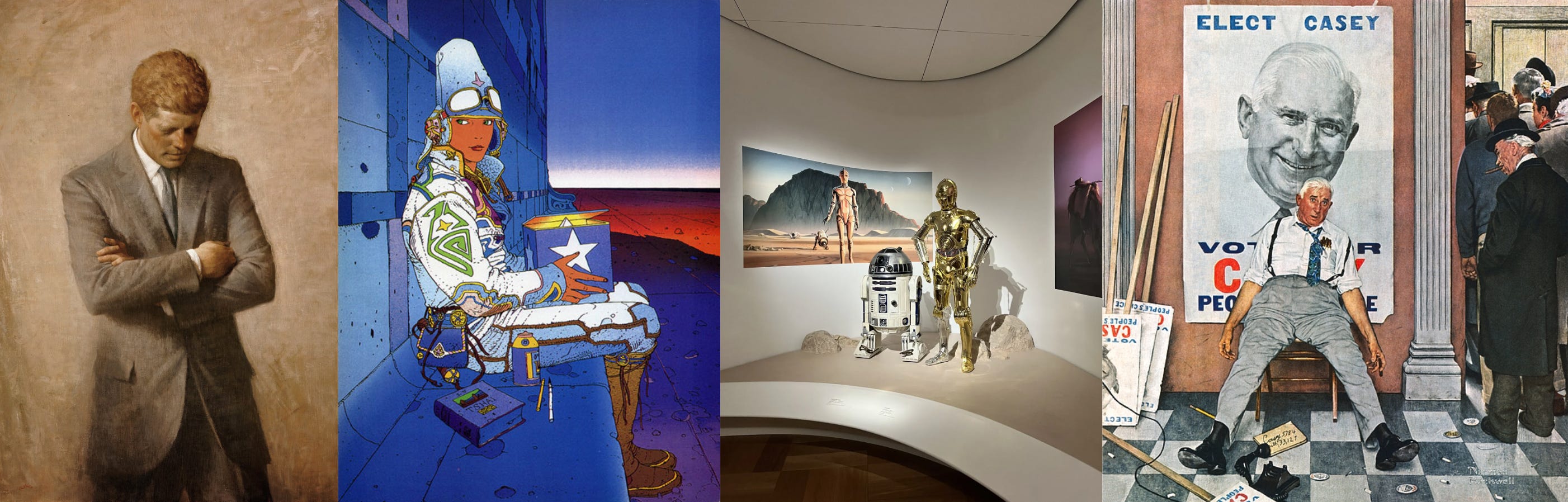
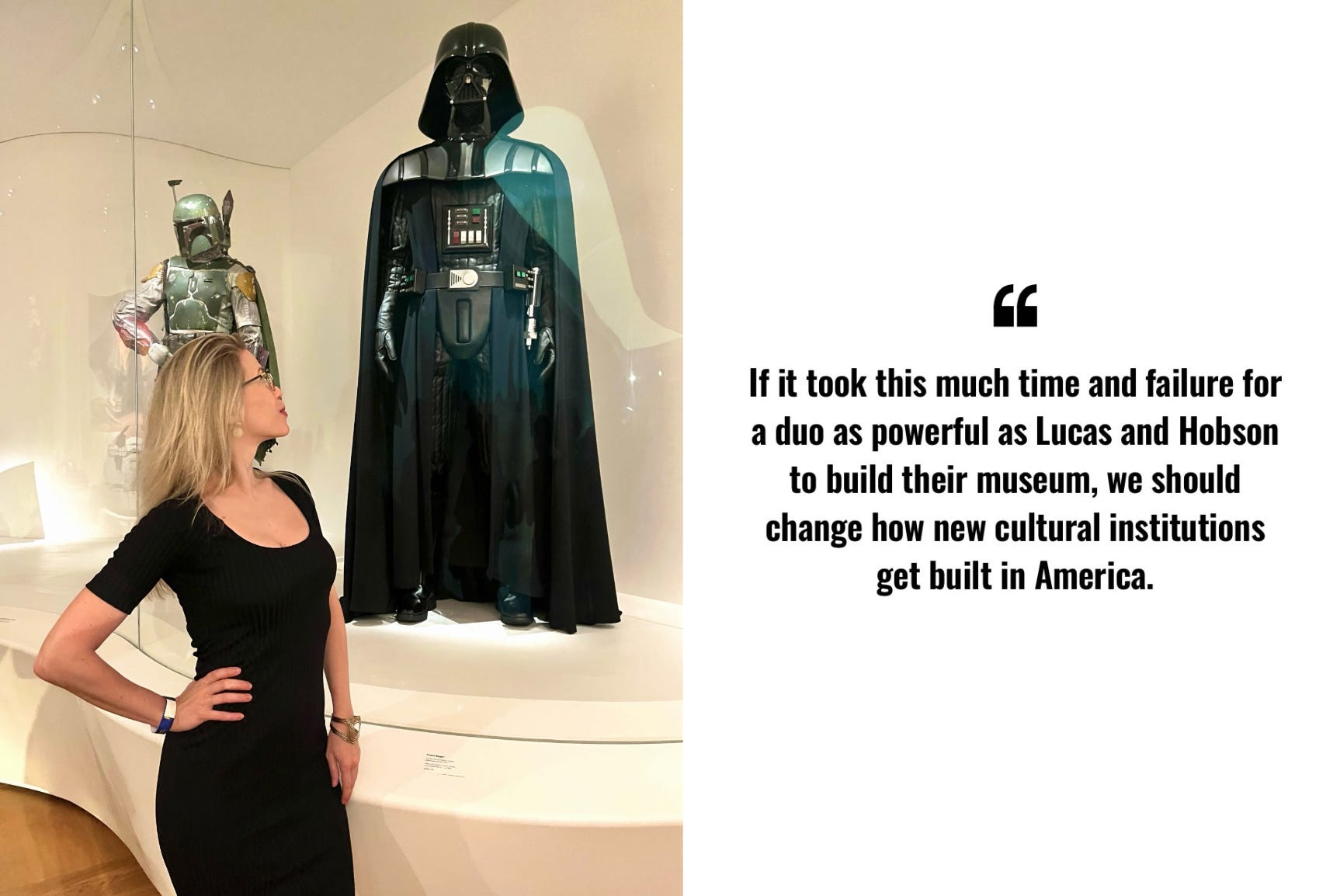
The founders of the Lucas Museum wanted a shrine to “people’s art” — including their own. All in all, I think they’ve succeeded. It is harrowing to consider that it took them 17 years — eight years just building the L.A. site. If it took this much time and failure for a duo as powerful, wealthy, popular, and well-connected as Lucas and Hobson, we should change how new cultural institutions get built in America. Despite these difficulties, the Lucas Museum is intent on celebrating America and its culture, from the most mundane to the most elite. Its collection doesn’t rank artworks by the old hierarchies but by what it expects to resonate with the audience. Lucas can thank the crowds for turning him into one of the most important filmmakers alive: In America and around the world, people keep watching and loving his movies. If anyone should trust the audience to be able to vote with their feet and their wallets, it’s him. And he seems to have learned that lesson well, and is willing to teach it. In his museum, Banksy, Frida Kahlo, Norman Rockwell, and Luke Skywalker — the costumes of Batman or the Lion from The Wizard of Oz — get so much floor space because We the People love them, because they are important to our self-understanding.
A good lesson for how to trust the audience. Build more cultural institutions that are actually useful for people. Base them on generosity, always.
Let’s go!
