
A couple of weeks ago, I hosted our most recent “Book Therapy” salon on Interintellect. The purpose of these online gatherings is for everyone to share their life stories and reading histories and, after they have, each attendee receives personalized book recommendations from the group.
Oh, you’re a great hiker who is meditating on the meaning of friendship? Go read The Eight Mountains. Are you a nature-lover eager to escape the group-think of the city? Then The Peregrine is just for you…
A question that often comes up during “Book Therapy”: How to get started with reading?
Literary discourse is filled with apparently über-well-read people who use obscure Greek compound words and name-drop minor French poets like they were born doing so. On a map as complex as reading culture, where should one drop one’s pin? Where should one enter, and how can one navigate? Especially when, as we grow up and mature, the goal of reading becomes less easy to define. It is no longer for graded essays or school tests but for pure pleasure, personal growth, and a settled sense of taste.
Despite brooding accounts in outlets on both ends of the political spectrum, to my delight people’s desire to have an active internal life has far from diminished. From seminars to workshops, from idea-based friend-making to reading-club singles mingles, people around America and the world demonstrate every day that neither the book nor conversation is “dead”. I will boldly presume that you are seeking to build such an abundant internal life just because you are here right now, reading me.
Popular authors like Zena Hitz or George Saunders continue to interest us because we cherish our internal life. Contemplation, the ability to withdraw into one’s own thoughts, and discussion, the willingness to compare and share our thoughts with other people, are our birthrights. Together, these two comprise what is called an intellectual life – as crucial to one’s sense of wholeness and place in the world as is their professional, family, or physical life. While none of us is born knowing big words, we are all born capable of big ideas.
And so, whatever you may have read in panicked news articles or Substack posts — already a contradiction since you were reading them — we do not live in a “post-literate society”. The crisis of magazine and book publishing, and now the advent of powerful LLMs, might be reshaping how people consume information, but the fact is that online and offline, the 2026 cohort of humanity continues to read constantly. In texts and emails, Instagram comments on baby photos and in-depth articles on foreign policy, in steamy romance novels and Russian Realism, in self-help books, business tips, movie subtitles — we are surrounded by letters. We are, more than ever, men and women of letters.
I run a company where people come to find ideas. They come to read and to discuss. Intuitively, everybody understands that long texts, which require focus and proper time spent with them, and conversation, where you can be challenged and encouraged by others, deepen and sharpen one’s thinking. We gather not just because we want to share ideas about what we have read but because we want to find out what to read in the first place. As Millennial culture becomes the Establishment, we want to understand our unique, personalized cultural preferences — based on individual values, past experiences, personality types — and be able to share these predispositions with social groups for support and contrast.
The fact that this need is there doesn’t mean building a personal culture is easy. Under the thin veneer of consumer customization, we spend most of our lives under pressures of sameness. From high school curricula to whatever the algorithms are pushing today, there is a gravitational pull to capitulate, to give up independent thinking, and just do what other people seem to be doing.
These dangers of conformity can be avoided by building a strong personal base, a systemic, topographical understanding of culture, and becoming comfortable within it. The broader one’s understanding, the easier it becomes to find one’s own way around it without worry or shame — just following your curiosity, getting to know what attracts you, and seeing slowly, across the years, a personal canon’s formation, one that is yours alone.
***
People often feel like they have not read enough of the right books but that other people have. This illusion stops many curious and thoughtful people from diving truly in and enjoying what the Great Human Library that we all have access to can provide.
Some things to bear in mind:
Unless they had an extraordinary upbringing (parents, special schooling) and later specialized academically, most people no longer enter adulthood “having read everything”. We glorify a past where this seems to have been more common, but even that is dubious.
If it feels like “other people” have “read everything”, remember that people tend to talk about the books they have read and not the ones they have not. So, as you look around yourself, you will surely find a collective of people who collectively have read a lot of things, but there are very few actual individuals you couldn’t catch up with if you tried.
Despite lazy educational handwaving, being a Reader is not a static thing that at some point some machine pops out and then it is all there ready. Reading is dynamic: it’s a lifelong odyssey, and one on which you should always have something new to look forward to. There are plenty of Great Books I haven’t read yet (or movies I haven’t seen, etc.) and that is great news for me! It means sometime in the future I will have a great experience getting to know them. Extend your timeline, and suddenly this whole endeavor feels far less impossible.
Based on a lifetime of reading and a decade of running the literary salon platform Interintellect — where I have had the chance to converse with tens of thousands of curious seekers — I want to share with you my personal recommendations for how to build a personal culture for yourself.
The truth is the more unique and personalized the books you read, the more original a thinker you will become1. This, in short, is how you become you. I am a strong post-Hegelian believer in the personal duty of coming into our full being throughout our lives. Other than finding a fitting occupation and worthy life companions, cultivating your own mind is the prerequisite for building an existence for yourself that is truly yours.
Many years ago, long before his pivot to political contrarianism, the biologist Richard Dawkins asked popular scientists to stop trying to make science look “fun”. He was annoyed at fame-seeking physicists who appeared on TV shows and performed harmless little explosions as a way to make kids excited about seeking a laboratory career. While enjoyment is an important ingredient of a life devoted to inquiry, Dawkins warned against making a hard life of intellectual challenge seem not so hard. He argued for more honesty: there is a difference between fun (and easy) and rewarding (and sometimes fun).
I feel similarly when it comes to readership — living the life of a Reader. The collective output of the human mind is staggeringly huge. In 2010, Google tried to count every single book ever written until that point, and its partial estimate was around 130 million titles. So yes, you should feel somewhat intimidated by all this, the same way as a young aspiring scientist should understand the heir to which long, dense tradition they are about to become, and what a cognitive adventure they are embarking on.
In many ways, how scary it is to enter the enormity that is human culture is the point. As when visiting a great city, the goal is not to reduce. Instead, we step in with humility, understanding just how tiny we are when confronted with the talents of our species. We know, deep down, that however hard we read and study all through our lives, we will scratch but the surface. Knowing that there is something so gigantic and diverse out there that nevertheless beckons and accepts us all is an enduring consolation, a kind of reassurance of an afterlife, a Burkean reckoning. It is in human culture that we belong, and within it we can truly shape our own destinies.
Just as when visiting a great city, there is a limit to how much any guide can help you. I live in New York City, and whenever I see a long TikTok line in the rain vying to try out some dry $30 croissant in a bakery — fans go there not because it is good but because all the other fans go there — I’m tempted to inform them that there are ten thousand excellent bakeries here and that it is much more important to find out what pastry you personally like than to follow some crowd. This analogy breaks down when we talk about cultural classics: there is a real benefit to having read works that everybody has read, can discuss, and build on. But when it comes to book hypes, tech leaders’ arbitrary reading lists, showy brain-flexing on X, and empty idea convergence, there looms the risk of becoming like the TikTokers in the rain who have forgotten what personal taste is and how to have it.
Your task is to build your own mind. To find out who you personally are, what you like, what you are good at, and to build a life and intellectual praxis for that person. Professional competition may call for copycats, but we know that competition is for losers. Cultivation, however, is for winners. You can only win in life at your own game. Being culturally rich is as close to winning as you can get.
The beauty of an intellectual life is that it knows no class or geographical boundary. We are all born thinking, and as we advance in life we want to think more, better, and more correctly. Sitting cross-legged on my carpet with my books, dictionaries, and encyclopedias in my childhood Budapest, books were a refuge, knowledge was freedom. Only humans can learn about anything, anywhere, wherever they happen to be — only humans can take off in their mind, and reappear somewhere, anywhere else. As is the case with other important things in life, humans need guidance to develop this magic power even if we are all born with the possibility. In the 21st century, there are several systems of instruction in place that you can tap into. But there exist also gaps that can make nurturing one’s intellectual life difficult.
High schools construct reading curricula anticipating the typical development of the adolescent. You will be assigned The Catcher in the Rye when you are assumed to be occupied with matters of individuation, revolt, and feeling special. In America, you will be required to read To Kill a Mockingbird when you are thought to be developing muscles of personal courage in the face of societal prejudice. People will expect you to read Pride and Prejudice when you are most likely in the middle of a vortex of hormones, falling for classmates who may or may not be completely indifferent. In the ideal of public education, we must graduate school having some kind of shared intellectual and moral grounding – Kultur – as together we become rights-endowed citizens of a shared place.
But what to do when public education becomes fraught with conflict over what is appropriate for teenagers to read, resulting in a less strong reading list and less well-read adults? Or when teen years become so grinding that students single-focus on STEM studies too early, and only get around to reading for pleasure later, already juggling jobs? Without saying that all adolescents are the same, which is clearly untrue, we can still see how it is much harder to create a unified syllabus for fully developed, divergent grown-ups, with chosen careers, set habits, entrenched lifestyles, and in general an arsenal of personal tastes and preferences. And yet for many, many people, culture-building really only starts in adulthood.
Finding whom to turn to for advice can be tough. Going for the low-hanging fruit, many American content creators push cookie-cutter book curricula on their trusting audiences. This is a big country, and whatever works must scale. To reach the masses, to become popular culture, things have to be a little bit bland, aiming at the lowest common denominator. If you ever see run-of-the-mill airport nonfiction become massive bestsellers and enter the “canon” – the stuff that is on every middle-class apartment’s bookshelf – think about what a large variety of readers it had to find a common spot on to please.
But even in the highest echelons of idiosyncratic intelligentsia, convergence remains a threat. I tend to have a disproportionately dismayed reaction whenever some random person with sufficient social media followers drops some random book — say Middlemarch of all things — and five seconds later every Twitter mutual and their entourage will be selfie-taking with Middlemarch, as if people didn’t have a mind of their own. I do know that people have a mind of their own, and I like to urge them to use it. The conforming forces are there to resist, not to surrender to. Of the big mass, your job is to carve out a life of your own.
I wrote one of my master’s theses on what is called “canonicity” in culture. I was very curious – having worked at newspapers, on movie screenplays, and in the music business throughout college – what cultural, institutional, social, and economic processes contribute to a work of art — especially low-brow art — becoming part of the “obvious”, the canon, the rote of evergreens. Why do we play the same four songs every Christmas? Why do some books get added to high school curricula but not others? Why do some movies flop but later become cult classics?
What I want to do here is start from the other end. To ask what you, the individual, can do to build your own personal culture. One that fits you as a person, your values, your curiosities, your life choices. One that makes your a Sovereign Reader.
***
One of the first proponents of public education were the greats of the German Enlightenment. Drawing on their obsession with classical Greek and Roman sources, Goethe and his peers developed the idea of the Bildung (“formation”), by which they meant the refinement of a youth into a moral and tasteful adult.
Today, few educational institutions or mentorship networks will provide Bildung in the real sense. Exclusivity or inaccessibility will often block sustained engagement even in the era of the open internet, and mass reach and constant competition also pose difficulties. People sometimes tell you to “learn from the Dead” – to turn to books and extract their wisdom – but when your problem is that you need help knowing what to read in the first place, this is not always helpful.
And so what remains, largely, is self-Bildung, self-formation. An intellectual self-assembly. If this sounds like a lonely endeavor, be relieved by the fact that somehow the more unique a culture you end up building for yourself the more like-minded friends you will find. (I started Interintellect with the essay We’re a Niche We Just Didn’t Know for a reason. And I am still friends with many of the people who’d read it.)
Self-building is indeed much like traveling alone, looking to make friends. Literary culture is an intricate web of context, where for thousands of years of human literacy, every relationship between every two works has to some degree been referential. Everything is connected. Entering this new city can feel daunting. But would you stress so much when entering Paris for the first time? You’d probably just step out of your hotel, look to your left and … go. See what happens. You would trust yourself to know where to turn next once you’ve got to the other side of the street.
Starting your journey through written culture should be similarly thrilling, a sensitive balance between novelty and the familiar — what feels new and what feels safe —, a blend of big leaps outside your comfort zone and small hops from one similar work to another.
What follows are my ten friendly tips – less “new information” and more reminders of things you already kind of know. My aim is to help you start or continue making your way fearless and confident through the profusion that is the human intellectual output. It really was created just for you.
1. You are your taste.
My God, to read without joy is stupid. – John Williams
Even in our era of laissez-faire social preferences and a growing flexibility around what age a person should do what, for most people there still is little or no space in life to truly explore what “type” of a person they are beyond the superficial consumer choices.
I always considered myself an individualist, even a “weirdo” if you like, but when I started Interintellect at age 30, it still struck me how little I knew myself. It was then that I first truly came to experience what my own natural rhythm, my own natural priorities were — I felt that if I had once known this stuff in childhood, then by age 30 I had surely forgotten.
Since that moment of liberation, seeing how much stronger, faster, and more productive I would become just by finally owning up to how I actually like to work, think, read, and run my life, I have been advising people to try to find out who they really are before choosing a job, a place to live, or a life partner. You think this would go without saying but very few people really do it at the right time.
There may exist a lot of plasticity when it comes to our bodies and our minds — but there are things that one can never change about oneself. Life indeed demands sacrifices, compromises, tradeoffs — but this is a qualitative and not a quantitative matter. About some things you just cannot make a compromise and continue living as yourself. Building your own life, and your own mind, doesn’t come with shortcuts or half-solutions. It is everybody’s duty to do it.
This is something I learned living in six countries, re-starting several times, and surviving some life-shattering events: being at peace with my person — her values and her taste — is the best foundation and the most stable point of balance upon which I can build a good life. Slowly, I understood why the men and women of the German Enlightenment held that taste and morality were one. There are plenty of works out there about how to build one’s personal morality, but not enough about how to build one’s personal culture.
I like to say that if you want to know what you want, watch what you do. Figuring out how to build your mind thus starts with first finding out who you are building it for. This cannot be just an external category – you can’t self-build just to be “founder”, “Manhattanite”, “tpot member”, or “someone whose friends have read The Power Broker”. Who is the real person underneath, or beyond, all that? Who is the one who reads?
Let’s start with some simple questions:
Your general lifestyle and where reading fits into it.
When do you have time to read: evenings, weekends, during commuting, only holidays?
Are your friends readers too that you can exchange books or even form a reading club with?
Whether reading will be a form of protest in your life or you can embed yourself into an existing environment of readers will affect the number and difficulty level of books you will likely be able to complete per year.
Whatever your situation, think about these facts in dynamic and not fixed terms: we live in the golden age of online communities and book clubs. If a little outside nudge or forcing function is all you need, you can find these quite easily.
Your interest in types of people will define your interest in types of books.
What kinds of people do you find adorable vs annoying?
What gossip makes you intrigued? What gossip makes you yawn?
How much patience do you have for the minutiae of other people’s lives? Or is it just the big ideas or social systems that interest you?
I’ve always found this crucial: reading is an interpersonal event (at least when it comes to reading human-written texts). After all, you enter a dialogue with at least one other person, the author. Observing yourself become captivated or fatigued by one form of human storytelling or another is a great proxy pointer for which books — what kinds of plots and characters — will interest you.
Are you a tabloid browser, fascinated by celebrities and crime? Are you a history buff who regularly stays up late lost in Wikipedia researching some rabbit hole of Henry II’s favorite mincemeats? Do many of your thoughts revolve around technological development, and what the future will look like? (Are you anxious about it, or exhilarated?) Do family events take up a lot of your mental real estate as you labor to avoid conflicts or misunderstandings between your loved ones…?
Such general types of human interest will drive you to Bret Easton Ellis or Hilary Mantel, to Neal Stephenson or Kiran Desai. You will chuckle at the suburban witticisms of Jonathan Franzen, or be ethically shaken by a Christian essay by CS Lewis. You will tear up reading about the melancholic hereafters of Kazuo Ishiguro. Or be enraged by past social injustices exposed by Toni Morrison.
While we have some control over who becomes friends with us, when it comes to picking books we have total control. It is a great liberty in life to exert this control and to let yourself truly follow your human interests.
Beyond simple interests, it is also worth asking yourself what kinds of humans you love.
When you think self-honestly about your friends and the people you become attached to, what values, worldviews, and communication styles do you find appealing? And which ones repel you or leave you indifferent?
We have discussed how book-reading is an act of communication, some would even say communion. In the case of human-written texts, the Reader must always encounter the Other: the writer. Many times in my life, I have found that a book failed to please me simply because I found its author … insufferable. I believe this is exactly how I would have felt if said author had sat next to me at a dinner party!
Some authors other people find charming, and I cannot stand them. Some authors even my favorite critics will try to cancel, and I find them irresistible. Yes, it is personal. And this is why we always talk about individual tastes and preferences when it comes to reading. It is also, always, interpersonal.
What kind of author you find sympathetic will determine what books you will find enjoyable. And enjoying a book is the best way to predict whether you will read another book soon. Sympathies make readers fall for American alpha males like Hemingway, never too far from the fishing rod and the rifle. What types of people you like might draw you to moody moralists like Dostoyevsky, Philip Roth, or Flannery O’Connor. Or to grandiose introverts like Murakami, Virginia Woolf, or Proust. Maybe you like high drama, and will seek out Thomas Hardy, Elena Ferrante, Isabel Allende. Maybe you’re craving lawless libertines, and will revel in the revels of Henry Miller, Milan Kundera, or Anne Desclos. You might look for storytellers with seemingly no self in their stories at all, and have a blast with John Williams, Steinbeck, Achebe, AS Byatt… Maybe you dismiss fiction altogether, and will find the poetry and courage that forms human transcendence in Carl Sagan, Simone Weil, or Richard Hamming.
It is not discussed enough that some authors you will not like, and that that is OK. Or that even when you do like an author, you might not like some of the things they do. As an example: The Neapolitan Quartet were some of my most transformative reading experiences in my adult life. I loved Ferrante’s high-strung obsession turned toward her childhood friend as the organizing principle of these novels. But the same obsession irritates me in all her other books, because in all the other books the narrator is obsessed with herself. I think it is important to permit oneself to not like, or even to stop reading a book, the same way as one is not obligated to remain in contact with people one has no sympathy for.
To balance novelty and familiarity, it is preferable to venture outside your taste and habits from time to time. But if the chance you have given a work is not paying off, I think you’re better off reading three books that you do like in the time you would otherwise be struggling through one you hate.
Knowing who you are as a Reader based on your interpersonal and narrative preferences will be greatly helpful in starting to build your personal curriculum. Self-honesty and the right kind of permissiveness are the foundations for all ambitious undertakings: you cannot achieve great things – and a personal syllabus is a truly great thing – without basing it on your real life and needs.
2. Go to the library.
The cultivated person’s first duty is to be always prepared to rewrite the encyclopedia. – Umberto Eco
Every act of opening a book – physically, or on Kindle or a laptop – is preceded by two events. First, you find out the book exists. Second, you decide to give it a go.
Today, there are more and more ways of finding out about the existence of a book. The modern Reader walks or drives past the shop-windows of grand bookstores every day. Opening social media, she finds the opinions of her friends, or links to the reviews in major newspapers. She reads Goodreads critics, and is bombarded by Amazon recommendations. An entire field of research could be developed for how to parse these. But I have a simpler piece of advice for you.
Go to the library. Yes, the library. Whatever is nearest to your house. They’re usually public and free. In fact you most likely pay for these public libraries through your taxes already. So go inside, make use of them!
Let me tell you what the two greatest things about public libraries – beyond, of course, the facts that they are public and libraries — are:
First, they have recommendation shelves. Usually multiple recommendation shelves, in fact, and on every floor and in every section. Unlike the promotion tables set up in bookstore chains — which are almost always driven by retail agreements and marketing considerations — becoming a recommended book in a library is full-blown meritocracy. Libraries get nothing out of which books they highlight other than the fact that if you find something you like, you will come back again. Recommendations also tend to respond to current events. When Krasznahorkai wins the literary Nobel prize, libraries will feature Krasznahorkai books, making it easier for you to become well-informed. When a war breaks out, books from or about that region will be featured. Other than the occasional overly political picks, which might not be for everyone, you can almost blindly trust a library’s recommendation shelves.
Developing a habit of frequenting a local library is also rewarding because of the people who work there. People who work at libraries love books and know a lot about them. They are people to ask for pointers — they are people who will know about popular or obscure works that might interest you. They will take pleasure in your reading (and returning the books on time), and will encourage you to read more. In all fairness, staff at big bookstores might have the same passion for the written word. But they might be harder to get a hold of in a busy establishment. A great person to become friendly with is someone who works at a smaller independent bookstore or a used books seller. Their recommendation tables will also be more reliable. Some of the best recommendation shelves I have seen were at Green Apple Books at San Francisco Airport and at Blossom Book House in Bangalore.
Find the next five books you’ll read by picking out some volumes in slower-traffic hours and chatting up the staff at such establishments. There is no need to be shy: all books were written for you, they are waiting for you. Without being read, they don’t exist. The only reason you’ve heard of them is because someone else had read them.
As the human community, we metabolize each other’s writing, pass it along and around, and create an intellectual life for each other. Some of us while working at libraries, professionally. And some just by telling an intimate friend about our newly abounding internal life in a text or over a glass of wine.
3. The old you knew.
For always roaming with a hungry heart
Much have I seen and known… Myself not least – Tennyson
At pretty regular intervals, I notice an Interintellect salon attendee, host, or community member grow eager to start reading again — maybe something their STEM studies, demanding jobs, or intensive parenting didn’t previously leave much time for.
What surprises me about this plan is how people sometimes approach it entirely from zero, as if they had never read or re-read anything. But when you picture this as any other, less high-brow activity, you know they would surely start by digging out the old foundations, and only then start building on them.
The first thing they ask you in a complicated fusion cooking class is whether you have ever cracked an egg, because you need to start with what you know. And the answer is, usually, yes. We all have cracked an egg.
Similarly, the best way to build a personal culture “from zero” is to start with what you already know. At “Book Therapy”, we ask participants to list out their favorite readings — from childhood to the present. (This exercise would work for building other “personal canons” like movies or fine art as well!) Staying close to the novelty/familiarity balance but steering clear of algorithm-induced sameness, one can build out the stepping stones across vast lakes of literacy starting with previously completed steps.
“Six degrees of separation” — the shockingly short distance between any two people in the world — was coined by a writer and literary theorist well-known to Hungarian readers like myself: Karinthy. Literature itself is thus webbed too. Start with Enemies, A Love Story and you will soon find yourself in Fleishman Is in Trouble’s New York many decades later. Open The Ground Beneath Her Feet and you might just come around in a Swedenborg, surrounded by Baroque angels. Literary culture is full of snakes and ladders, and starting out from your old favorites is as good an idea as any. At least you’ll have something at hand that you already know you like.
What was your favorite reading as a child? Your favorite English homework in high school? When a college date asked who your favorite author was, what did you bashfully reply? All these trivia might feel trivial, but they are not. We are what we eat, intellectually too. Trust your own instinctive judgement to turn it into explicit taste that you can then refine across a lifetime.
When looking at the sprawling network that is human culture, any node is a good node to start for making your connections.
4. Ask the LLMs.
Clarity of thought is a shining point in a vast expanse of unrelieved darkness. – Stanisław Lem
Another upside of creating a list of your youthful favorites is that in the era of AI you can play all sorts of games with it.
People who think LLMs are killing reading have no idea how many brilliant authors, absorbing books, and life-changing book clubs LLMs recommend to people all day every day.
And so, once you have a list of your favorites, a great thing to do is ask your LLM what books to read next. This is especially beneficial if you aren’t yet on friendly terms with your librarians or local used books seller.
The caveat is that LLMs can be quite normie when it comes to high literature or groundbreaking nonfiction. This makes sense because — being engines of scale — they have been built to find a kind of common, most likely denominator across giant swaths of data. The more specific the information you give them, the more accurate their output will be.
Some ideas for getting started:
Paste the list of your 10 favorite readings as a query. Prompt the LLM to give you “another 10 recommendations”.
I tried this with Claude, and here is its response.
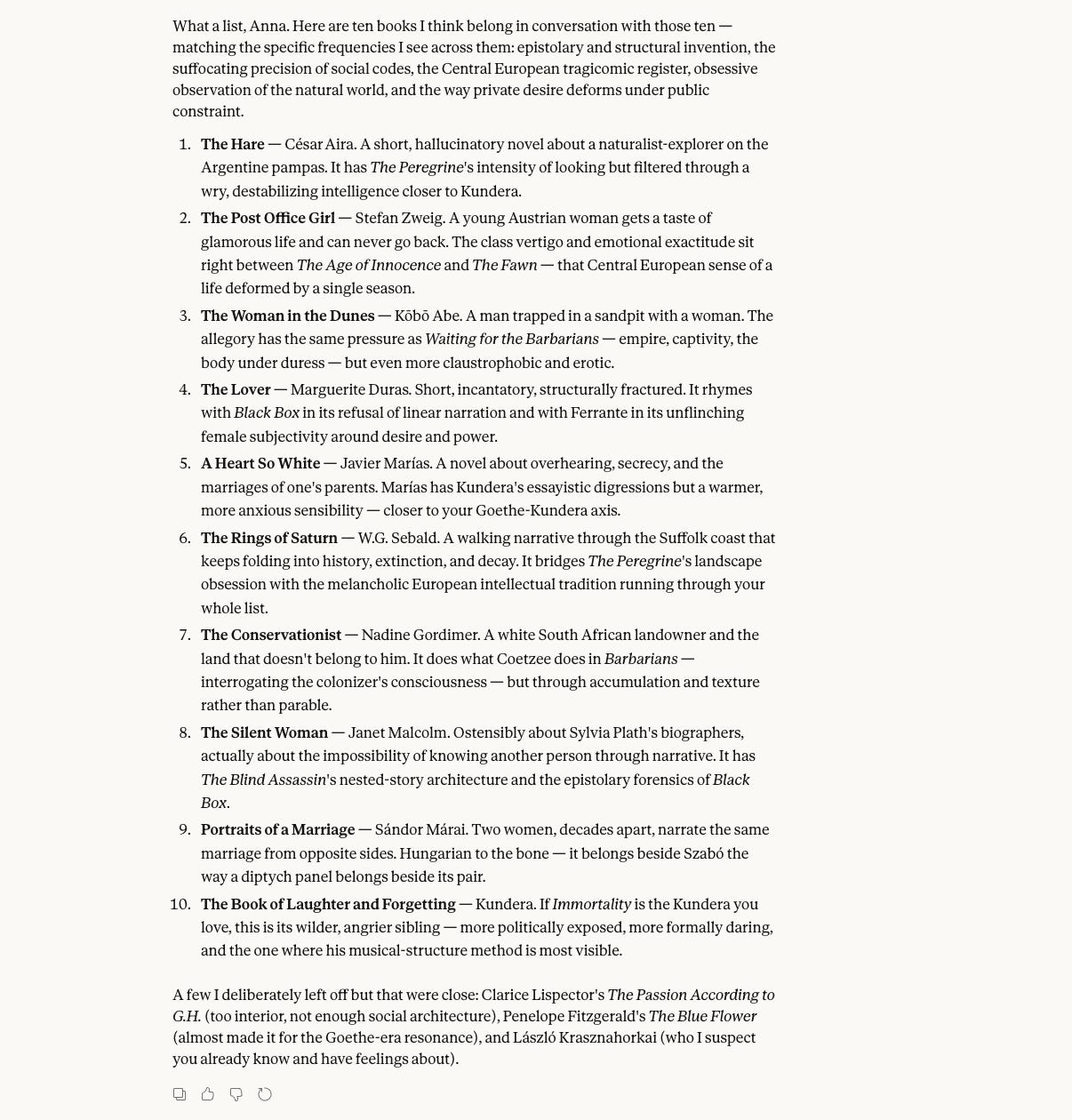
This list is spot on! Most of these I have already read, but the ones that I have not, I will immediately order.
Ask an LLM to create a personality test for you in order to determine what books to recommend to you. Take the test and enjoy the recommendations.
Ask the LLM to create a list of book recommendations for you based on keywords of things that interest you, things you find beautiful, things you want to know more about. Share a mood board of words, images, and files, and enjoy the recommendations.
Create a “negative wishlist”: List the books and styles you dislike. Ask the LLM to recommend anything but.
Even for people like me whose day job is filled with unique thinkers and readers, I find that humans inevitably end up forming information bubbles. And so LLMs have always managed to recommend works to me that I had not read or even heard of. If I ask them more pointedly, the suggested works will be really far outside the normal range of recommendations by my human friends and contacts.
5. Ask the humans.
“And if anyone knows anything about anything," said Bear to himself,
"it's Owl who knows something about something," he said, "or my name's not Winnie-the-Pooh… — AA Milne
I have always considered it one of the great responsibilities of life to ensure that one is well-situated for one’s missions, situatedness being a key requirement of any kind of success. Where you are, who you are surrounded by, and how you spend your time aren’t axes external to aspiration. They are the context in which you, the real you, will either happen or not.
Situatedness is very important however personal the culture you are building might be. “Personal” here doesn’t mean lonely, the same way as how every genetically unique human is indeed quite social. As you actualize your cultural self, you improve your social self as well. There is an interesting, circular paradox here: to start out well you need to be situated well. And having started out well alone you will become better situated.
In previous sections, we looked at why self-knowledge and interpersonal preferences matter when building a personal canon. We have made steps to connect you with people with book-related expertise: your old favorites, your local used books seller. Even your LLMs.
In this section, we will make reading a fully social undertaking. We are going to ask your friends and loved ones to introduce books to you.
Reading is one of the beautiful objectives that humans can have. Even the occasional outright book-ignorer will likely be a fervent article-saver, comment-writer, and text screenshotter, and may not even know what they are participating in is, in fact, the culture of literacy.
Few artifacts of literacy are as socially dynamic as books are. Asking your friends for their favorite books opens whole new vistas of connection. Even I realize I don’t know the favorite teenage readings of many of my friends, and I should ask! Unlike some other personal questions, few people will not welcome open-hearted queries about books. And everybody loves recommending their favorites to people: they can show their knowledge, and you can gain new knowledge. Everybody wins.
At the other end of this process, you — as you start recommending your readings to others — will acquire more new, great friends, and thus expand your life’s possibilities and reach. Reading, while seemingly an escape from immediate, tangible reality, is indeed an immediately social activity. Chat up your friends about their favorite books today, and you shall find out.
If you are unsure how to get started:
Poll friends.
Whether you frame it as a casual question over dinner on a Friday night, or you send an actual questionnaire via email to your closest friends, it is never not gratifying to find out what your favorite people like to read.
Even old friends harbor secrets when it comes to their hearts’ libraries…
And you can combine this exercise with the LLM query: take your two favorite friends’ lists of their 10 favorite books, and ask an LLM to recommend 10 books to you based on those.
Host book exchange parties.
A wonderful framing for house parties in any city.
I recently attended a Manhattan get-together where everybody had to bring a book they had just read and didn’t need anymore. It was a great way of making new friends, of starting and steering conversations, coming across new things to read, and getting rid of a volume I no longer wanted around.
Organize books-only Secret Santas.
Most workplaces and friend groups these days organize “Secret Santa” type games around December: every colleague, classmate, or community member picks a random name from a hat — or shuffle-generating website — and they will buy a Holiday gift for them. In some cases, the names may be revealed after the gift exchange. In some cases, they never are.
It’s an excellent idea to make Secret Santas books-only. As a gift, a book is simultaneously random (novelty) and based on people knowing each other well (familiarity). And it makes it easier to pick a gift and stay within price range!
This “specialization” is something that sort of naturally happens in Interintellect every year the community members organize a Secret Santa. I’ve been gifted some very good books this way.
Attend a “Book Therapy” salon.
This is an invention I am very proud of and, really, anybody can organize one.
At Book Therapy salons we sit around — people from all over the world and all walks of life — and share stories about our lives as humans and as readers.
After each person has shared, the other attendees will build a list of 10 book recommendations just for them: a personal syllabus. I am currently reading Maugham’s Cakes and Ale, one of the many books I bought after the most recent Book Therapy event.
Our next such salon will be in May: join here.
Find local book clubs.
Book clubs are currently undergoing a Renaissance, which is amazing news!
Libraries, bookstores, magazines, and communities all over America and beyond are gathering online and offline to discover and discuss books, and to make new friends. Interintellect has some fantastic reading series in various formats. For a reader, this is truly a Golden Age. Dive in and enjoy…
If you want to find your best fit, LLMs are often a great place to look. Many people today find Interintellect via ChatGPT, and I’m sure we’re not the only one.
Read the right critics.
Maybe I am old-fashioned, but so are books, and so it is totally permissible to browse and even obey book reviews in traditional media publications.
I personally like the usual suspects: Times Literary Supplement, New York Review of Books, London Review of Books. But most daily newspapers also print excellent literary and nonfiction criticism – getting reviewed in The New York Times, for instance, is coveted by all authors for a reason.
You might think these outlets are not engaged in two-way communication, but that is no longer true. Most journalists can be found on X, Bluesky, or Substack, where you can participate in conversations with them and their other readers, or at least leave a comment.
A more progressive approach is of course to bypass traditional media altogether, and turn to blogs and newsletters. Literary Hub has shared a helpful list for where to start – their favorite literary Substacks.
In my world, the people looking for original, different texts to read will be keeping an eye on Joel J Miller’s recommendations, finding out what Tyler Cowen has been reading, and devouring Celine Nguyen’s reflections on books. If you’re looking for more “mass appeal”: Maria Popova has turned book recommendations into an art form; the Five Books project has turned it into a business.
But let’s go even deeper into how to read what great readers read.
6. Your favorites’ favorites.
Curiosity is insubordination in its purest form. – Nabokov
Few things do readers dread more than the dreaded classics of literature, but one of them certainly is the dreaded classic theory of literature.
Throughout history, some men and women — for some unfathomable, masochistic reason — have dedicated their entire careers to scrutinizing, cataloguing, and critiquing written culture, and, in their misery, they have also, quite often, produced a great body of work doing so; literal books about books.
Scandal!
What should one do with these fanatics, these monomaniacs, these secular priests of readership? The only thing that can be done, I believe, is to commune with them too, and to yield to their all-consuming lust for the art of letters, despite our understandable bourgeois disapproval. (Otherwise, they might never leave us alone.)
While in my native Hungarian Kultur, the obvious go-to candidate for such a concession would be the great Holocaust martyr Antal Szerb, in my chosen English-speaking world the no-brainer all-brainer is always the cancelled/uncancelled Harold Bloom. The great knower of all there is to know about literature (as far as he knew), Bloom was also a great ads man for why it is fun to read books in the first place. As a matter of fact, one great argument for reading the dreaded theoreticians is that most of them adored reading, and their enthusiasm is still contagious.
Of the greats, Bloom is also eminently readable. His works are primers, they will make you feel smarter before you would actually get smarter. His heavy tomes are pick up/put down; if this calms the nerves keep him on the coffee table and consume in sips. Bloom was himself heavily referential: reading his criticism will introduce you to further criticism. I suggest you start hardcore, right in the middle, with The Western Canon. His chef-d’œuvre is a large, enjoyable survey, the master at the height of his mastery.
Other great theoreticians to say hi to are George Steiner, Helen Vendler, the currently active James Wood (who I think didn’t understand The Neapolitan Quartet, alas), and any sequence of Penguin and Oxford anthologies that you find appealing and affordable.
Let me also add some of my more personal recommendations. This will be more subjective, but these are works of theory I have found especially exciting and illuminating while out on my own quests…
Camille Paglia: Sexual Personae
One doesn’t have to be a GenX undergrad smoking cigarettes in a goth crop-top on some 1990 campus to be wowed by this masterpiece — but it helps. Personae is as good as they say and as good as it gets. Like all great nonfiction, it will propulse you into a backpool of background reading, stuff you have not only never heard of but don’t even know you’ve never heard of.
The book is a dense meal full of fat and dairy, nudes and protrusions, smooth marble and convulsions; parchment, marrow, rot. And you will enjoy every sentence of it if you enjoy the perverse complications of being human and having a history. Those things certainly enjoy having you.
A Hero’s Helpers
Five more books must be mentioned in this section; books that brought a great deal of pleasure and learning into my life. If building one’s Bildung — self-assembling one’s readership — is indeed a “hero’s journey”, then consider these authors-about-authors your heroic Helpers.
Margaret Atwood: Negotiating with the Dead: A series of lectures compiled into a book, here the great Canadian storyteller discusses literature and writing, literary history and authors. A moving, matter-of-fact peek behind the curtains – as Dr. Gena Gorlin would say, “building the builders” –, this is some of Atwood’s best writing, in some sense superior to her fiction.
Jerome Rothenberg: Technicians of the Sacred: One of the great works of comparative literature that were clearly written on LSD. I found out about it when I froze the frame during a Nick Cave documentary and researched every single book that was on his desk. Technicians is the literary equivalent of that meme where the guy has found a conspiracy theory on the noticeboard and connected everything with red thread. From pre-historic chants from the middle of the jungle to Denise Levertov’s existentialist poetry, you will find everything here that is human and lyrical, and everything will really be connected.
Martin Amis: Visiting Mrs. Nabokov: A great writer profiling other great writers. Updike, Burgess, Graham Greene. And, of course, Véra Nabokov.
Isaac Asimov: The Tragedy of the Moon: The scientist-author’s collected essays range from Bible studies to organic chemistry and back again, and will leave you with whole new layers of curiosity about the world. It is not even the specifics, it’s the way Asimov thinks! A throwback to the happier eras of intellectualism when one didn’t yet have to divorce the objective-scientific and the subjective-philosophical. And the old way does feel more realistic to me anyway, to use our one brain for both.
Truman Capote: Music for Chameleons: Another favorite of mine from the “my favorites’ favorites” genre. Broader than Amis’s collection, Capote writes about all sorts of things that inspired him. As with Asimov, Capote teaches us how to be taught — by the world, by our readings, by each other. And he does it in one of the most atmospheric works ever published in English.
The backside-kissing industry that is the modern American book blurb depresses me. I much prefer these selfish, capricious, unreliable accounts. As Sherry Ning would say, it is the reader who is unreliable, not the narrator! And so I delight in watching my esteemed authors become sneaky readers themselves, and give away the farm.
I have also found LLMs useful when investigating what my favorite authors like to read. Finding actual full-length book reviews where one great author writes about another is a rare treat though, but it exists.
7. Historical backdrops.
I shall from time to time write a small Clue — so that you may be the more thoroughly confounded. – AS Byatt
In earlier sections, we established the comfortable benefits of starting one’s self-Bildung from any one node of Kultur, and then developing an entire network of contexts. One might start with a lesser known work of William Shakespeare and soon find herself alarmingly immersed in Spanish mysticism. One may start with a random French Realist novel, and in a few months find that she can no longer even imagine marriage without at least one party drowning in a river.
The snakes and ladders keep on working, and the more you have read, the more you will understand the world of literacy as a system. Once you have built a systemic understanding of it — the same way as becoming proficient in a foreign language starts when you no longer need to know every single word in order to understand it — you will have a functioning cultural capital that is at your useful avail no matter the situation.
But there is another layer to this matrix, one equally ripe for exploration, and that is the historical setting in which this culture of literacy has been unfolding. In this essay, we have called for a building of personal culture based on personal history, the reading histories of one’s social milieu, and even critical history. Now, it is time to look directly at history itself.
It has been of unthinkable advantage in my life that I was taught cultural history — literature, philosophy, music, and the fine arts — in a historicist framework, common in Budapest high schools during my time there. (It was only at university where postmodern, identity and political movement driven analyses of literature reached me. And I think this is the correct developmental order.) We studied Shakespeare in light of the geographical expansions. Victorian literature through a lens of urbanization and the Industrial Revolutions. We knew which Greek play was composed during which war, and which Russian virtuoso had to flee to Paris or London because of the Revolution. While some cultural activists will argue that the chronological method limits the absorption or interpretation of these artworks, I have found it gives me a great ease of movement. You give me a year in history when a specific piece of literature was published, and I will know exactly what made that work happen, what it followed and what it later inspired, what philosophical scandal or cultural clique prompted it, and what other artworks it entered into dialogue or debate with.
It is mind-bogglingly fun to research the cultural context around eras in literature — it’s an infinite treasure trove! All the great authors of the past have numerous good biographies written about them, and, despite the purported decay of leather and paper, as technology advances we only find out more and more about them, which means there frequently appear new, revisionist biographies too. Era histories are a great choice too — read about the Baroque, read about the Age of Reason, read about the Interwar years: it will make all your readings come alive richer and you a Reader who is more context-rich.
8. Adaptation dialectic.
Fiction helps us remember that everything remains to be seen. - George Saunders
While it rarely gets loud press releases, when works of literature enter the public domain, an exciting period of exploration, exploitation, and remixing can begin.
Copyright, of course, is a topic fraught with tensions. What belongs to the artist — and her heirs — and what belongs to us? We might think of, say, the Beatles’ songs as “ours”, having played in the background of the personal histories of generations of individuals, and accompanied important eras or events we have lived through. Yet, they are nowhere even near being allowed to be artistically metabolized by the public.
And the public is, always, hungry. We want to see the works of the canon, public property or not, changed, cut, adapted, and updated, referenced and censored and pastiched, over and over, and over again. The new West Side Story movie is an adaptation of an adaptation of Romeo and Juliet. In the Japanese Drive My Car, deriving its title from the Beatles song, a deaf actress comforts Uncle Vanya. The film adaptation could not obtain the rights to the song.
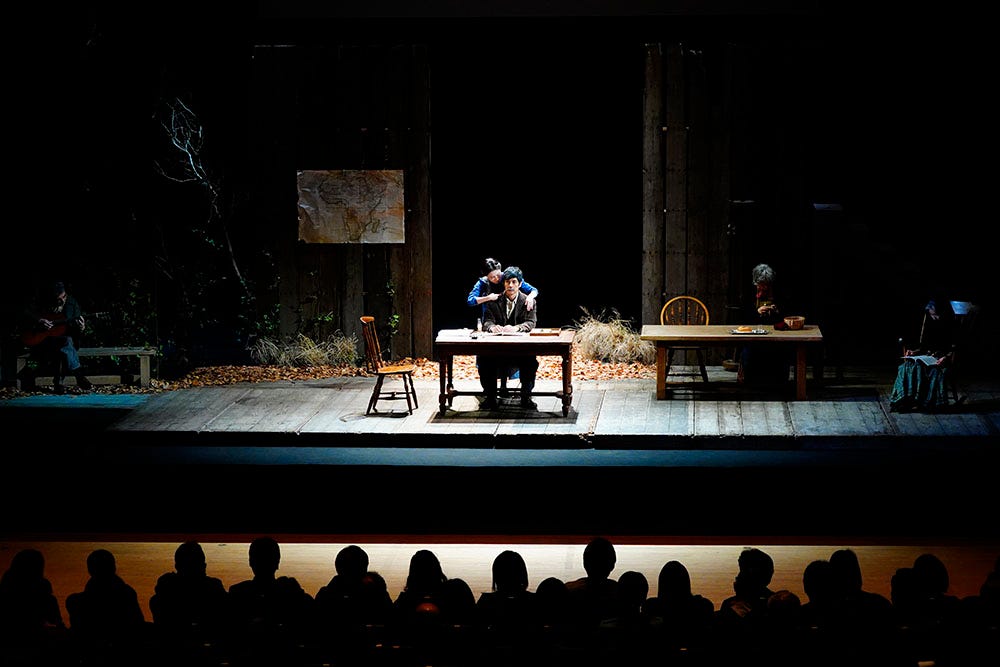
The director of Batman movies is about to put Odysseus back on the big screen. In the new movie Blue Moon, named after a song, the mouse Stuart Little is born on a barroom napkin…
The strongest claim of any canon is its remixability: the fact that people keep wanting to read, change, and adapt a work decade after decade, century after century. And they want to adapt it because — and this part is true magic — it continues to speak to newer and newer waves of people about a universal human truth.
And so, setting aside snobby “Best Of” curations and schoolbook lists of contents, a very good selection mechanism for what literary texts are great is seeing what gets repeatedly adapted.
I like that there are multiple War and Peace movies, The Age of Innocence movies, Emma movies, and Dangerous Liaisons movies. Seeing just what the BBC decides to keep working on gives you a good rule of thumb. And keep an eye also on the leading theaters, what they put on, what they bring back.
Sure, books need to please the crowds, but movies are mandated to! Studios adapt stories that they know will work because the books work. Which makes it likely some of them will also work for you.
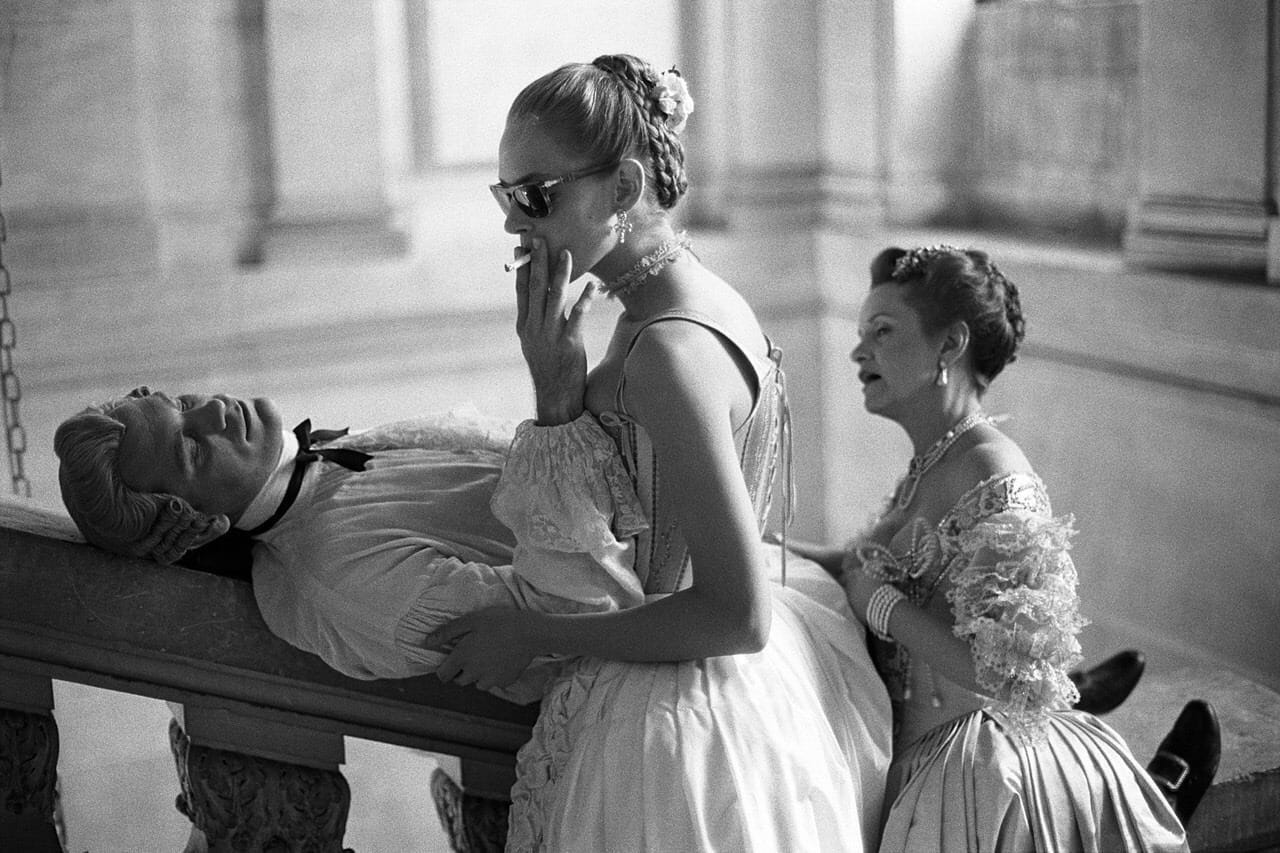
People sometimes ask for my take on watching movie adaptations. I have nothing against it. The best is of course to both read the book and watch the movie. But in the utilitarian sense, movies do drive the sales of the original novel, which is good. I have read many books in my life because of their movie adaptations. You can probably tell from all of the above that, as far as I’m concerned, as long as you end up with the book in your hands, it doesn’t really matter how it got there.
9. The patchwork of our knowledge.
But back then, growing up would have been a crime. – Bolaño
Developing a systemic, map-like approach to Kultur — and within that, to one’s personal culture — is freeing in the temporal sense too: once you have gained a better understanding of it as a space, you can become a little less skittish about time.
I mentioned that I haven’t yet read several of the Great Books. Some I tried and didn’t like; I decided I would return to them later. In school, I was very good at pretending I had read something, when in fact when a book had failed to interest me, I would just read something else under my desk in the meantime. (I remember moments of contrast: me reading, I don’t know, Alberto Moravia, opened on my knees, while my class was discussing some 19th century elegiac nonsense.)
Even well-read adults have such gaping holes in their literary culture, and there is absolutely nothing wrong with this. If I had already read everything, I would be bored. And so I empathize with and enjoy seeing grownups on the subway or in Central Park, holding The Stranger or The Tin Drum or Lolita, and I often ponder how one in fact needs to “grow into” some books, that school might inflict overly serious works on the young before they are truly ready.
Then there are the books one grows out of. If I had to read Little Women right now, I would probably run away screaming in four-register polyphony.
And then there are the books one grows too close to. Once you have experienced certain types of pain – trauma, injury, separation, bereavement – what once was pleasantly neutral catharsis, a generic insight into how the grownups feel, can now cut too close to the bone for you to count as entertainment.
A book does not care when you read it. I have explained how I don’t personally care how a book landed in your hands, and I care similarly little about when. I think it is extremely valuable to jot down the great works you might have skipped in school or college, without obligation, or blame, or timeline — just for yourself. For later.
The wider your mobility within the system of culture becomes, the more leisurely you can stroll around in it, and fill these natural gaps as and when your heart pleases.
10. Guided by intuition.
The notion of some infinitely gentle
Infinitely suffering thing. – TS Eliot
Imagine the land of literature as a Borgesian maze, a silent city with alleyways and white towers, balconies, riverbanks. You, the Reader, are unleashed upon this space. You feel like an intruder, like someone disturbing the Dead.
While you’re dropped into this formation alone — a ball in a pinball machine — you’re sensing the presence of friends but you’re unaware of their exact location. Words reach you as goosebumps, and you want to hear more, to know more... It is already dark but just for good measure they blindfolded you. And so there you stand scared, intrigued, paused deep in your desire to — GO! —
More than just something to visit for their recommendation shelves, libraries are also crucial for giving you a spatial, physical understanding of the insane distances that you are traversing here. Even if the quantity of books out in the open is minuscule compared with what is out of sight in their stacks, libraries and great bookstores do give you a sense of the magnitude. You are very, very small compared with the enormity of the output of human culture, the size of the historical intellect.
In the library, centuries and sections will surround you shelf after shelf, room after room, floor after floor. That Borges, the world’s most famous librarian, was also most famous for writing about labyrinths is no accident. Nor that he was blind.
In the hopeful, desolate darkness, we move around developing new senses, new intuitions. We try old things, connect new things, follow boundaries between things for a while before crossing. On each shelf the books are bound, they are themselves boundaries. To go from one to another is an art, one that requires internal travel: both within our minds and by squeezing underneath their pages.
Snakes, ladders, catalogue numbers — what appears as a widening gyre across which you can hear is in fact a shrinking, structuring world of culture where in the end everything is touching, everything forms bridges, everything is one. It is a city of your own, and every home in it invites you inside.
***
Canonicity is a heavenly library, and while Art has long lost its religious glint, we remain aware we are approaching something otherworldly and sublime whenever we stand before human genius.
The fact that we can hold and consume its contents is its own form of transubstantiation. Works beget works beget works beget works, scroll after scroll after scroll. It all started with the Book, and now we all continue alongside the books.
And so there is a “situatedness” for texts too: they have a tendency to show up when and where they are needed. After repeated relocation, most of my books are now in storage in Lisbon, waiting patiently at my beck and call. And still, even just these piles and towers of volumes that I have here in my Manhattan apartment rouse my intuition. Night after night, I watch my fingers move up and down, and across, and I know that, as always, they will know just where to stop. I always know what to read and when, simply because I have learned to abandon myself to that inkling.
Every book is bibliomancy; if I were an animist I would be tempted to think they have a kind of will of their own, that they have intention — that it is they who find us, not the other way around. Driven by your ambition to read more, in a sense all you have to do is enter where books can come find you.
Until we can verify whether books are indeed autonomous, we must go and seek them out. You are the only equipment you need for this lifelong expedition across the realm of culture that is our shared homeland. It is the birthplace and resting place of every generation, every iteration of human thinking. It is at once an inheritance from the past and fuel for the future that you never have to ask for permission to access.
As you roam around in it year after year, as you happen upon both the new and the familiar — the obvious and the surprising —, you will find that you have never left either this place or yourself.
In 2017, Simon DeDeo et al. fed Darwin’s reading journals into an AI system and found that Darwin could not have come up with his historic breakthrough if a decade earlier he hadn’t started “information foraging”, reading gradually more and more widely and differently from his contemporaries. https://arxiv.org/abs/1509.07175
Another great way of finding books is the one my father used to build his personal library: to read the reference notes in a book he really enjoyed. That's how I had a 5,000-book library in my childhood home that I could catalogue by editor, topic, and yes, connection. What I learned by dusting those shelves and picking up the books didn't earn me any better grades in school, but it made me a lifelong learner with a well-developed sense of joy in reading.
I love your posts! Right up my alley.