

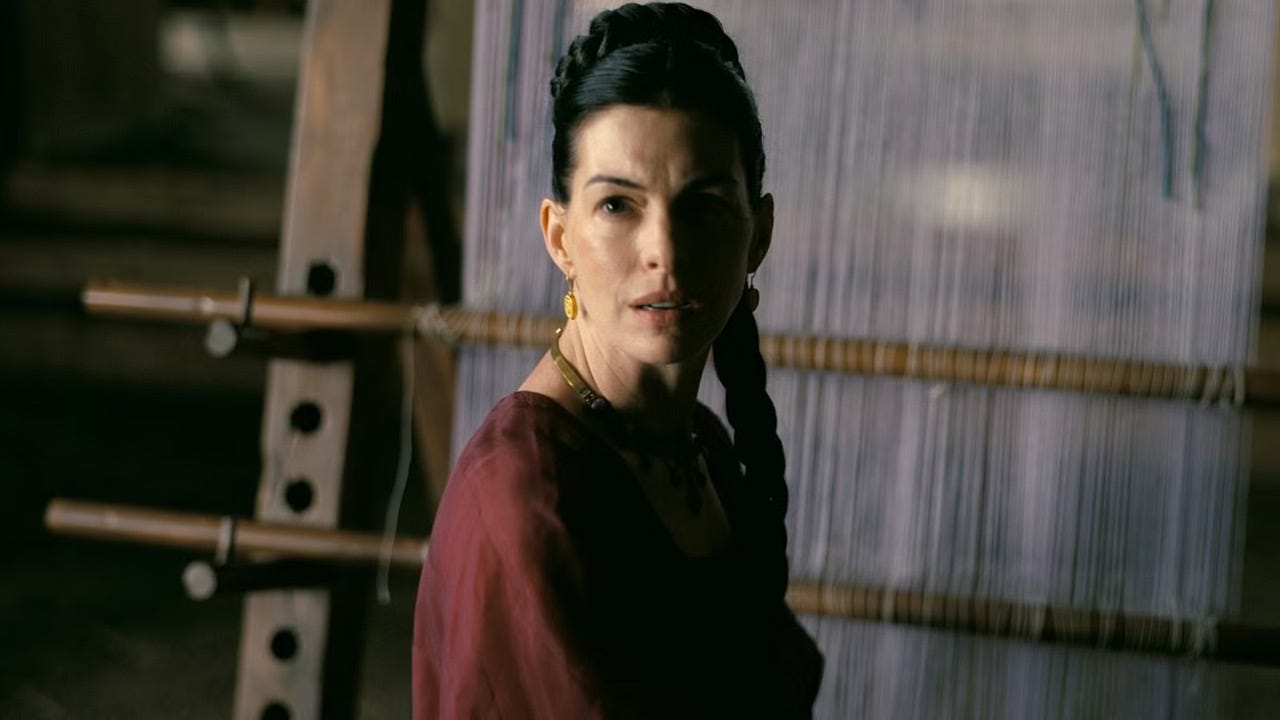
A late-night screening of the new movie by Christopher Nolan -- a filmmaker whose previous movies I always failed to fully warm to -- left me speechless with its ambition, its grandeur, and its rediscovering of universal human beauty. I decided to gather my thoughts anyway, because something really monumental has just happened in cinema, in literature, and in art in general, and it’s worth saying why.
1) The Odyssey reminds you that movies are supposed to be a physical experience.
Our most multi-sensory artform, it is not just during action movies or horrors that you should feel like your body is part of the viewing process. This is something casually forgotten in the Netflix era.
The new film adaptation of The Odyssey, true to its ancient source material, is not just epic but downright overwhelming and literally monstrous with its vast arsenal of feelings. It is about humans and gods and so it knows it’s supposed to be “too big” -- and thank God it is.
After the movie I felt that a physical event has happened to me. I feared, I cried, I laughed, I jumped, I desired. I was exhausted, I was revitalized. I had given up and my hope was given back to me. Every human instinct in me had been moved. Because Homer writes about entire lives -- of people, of cultures -- this is a rare instance when form and content are in perfect harmony, which is a rarely achieved goal of all of aesthetics. Big story, big format, big feelings. Bring it on.
The original Homer is disorienting in its switching back and forth from totalizing vastness (of battle, of sea) to zoomed-in, tiny, personal moments (a dying dog, a man weeping on the beach with homesickness). Hollywood has a surgical template for how to alternate between the two and Nolan does not use it. He keeps the surprise of the original text of when you should be moved and when you should feel like a bulldozer has just passed over you.
(The great Olga Yakimenko wrote recently about the need for more sumptuousness in cinema. Well, we now got it.)
It is very hard to express to a modern audience just how physical the lives of people in the Antiquity, or in fact any time until modernization, were. What food meant, what wounds meant, what sex meant, what being on roads or the sea felt like. The Odyssey made me realize the physicality of all my other feelings too - my longing, my surprise, my mischievousness - as it recreated a world of old bodies, of good old life and death.
2) The adaptation understands the monomyth.
At first, I was struck by the fact that this is a very “English” adaptation of Homer, and not in a way I found distracting. Green hills, grey skies, blond heads, rain. It rang a bell. Then I understood.
As we start “cataloguing” the characters and locations at the beginning -- just like Homer does -- I realized we are about to start sweeping through various areas of myth -- because Nolan understands that he’s dealing with *the* foundational myth of our civilization, and that as a result he is in a birth-of-gods territory. He both has to show you the diversity and decentralization of all these Homeric mini-states, yes, but also how this is the core of all of Western storytelling: this is the story all the other stories come from.
And so you soon realize that the Ithaca court has an almost Medieval, Celtic knight-era quality to it. The ship you see is real, and it is Viking, like Freyr’s in a Norse saga. The witch is out of Macbeth. The abducted beauty out of Arabian Nights. The slain priestess out of Euripides. The speaking dead out of Ovid. The sea-nymph lives in a Borgesian maze, where the maze really is your mind.
Tolkien lurks around the corner because in Tolkien Homer did. This is where all your categories and characters, tools and devices, story turns and revelations come from, we are in the delivery room of literature, and it should feel like that. All of literature is a footnote to Homer.
I was pleased with the casting not just because the ancient world was incredibly diverse and multiracial (in large part due to wars and slave trades, but also commerce and randomness), which to a modern audience can indeed be expressed the way this movie handled it.
But also because it was crucial to visualize that this story is truly for all of us. It is ours, it has been for 3,000 years. Sitting in an IMAX theater in Manhattan, among people many of whom like myself originate from the other end of the world, I was watching an epic about ourselves, and it worked.
3) It shouldn’t work but it does.
I always saw Chris Nolan as a master craftsman one respects but does not love. He has been telling us a story -- as my friend @eugenewei pointed out -- about going home (or at least missing a wife) all his career. And I always “got” it: got the issue with the guy in Memento, cognitively grasped why DiCaprio’s character was sad, or why Interstellar is such a big deal. But I never **felt** it. I never until last night believed Nolan. He always shied away, the last minute, from telling me the truth.
Last night he told it. Nolan literally needed the protections of a 3,000 year old story -- so well known that even if you know nothing about the Homer text, most of it will feel familiar from all the other texts and works inspired by it -- to bare his heart. Men would rather adapt a 3,000 year old epic than go to therapy? I am here for it.
I am familiar with multiple translations of the text and had seen and read several adaptations and derivations, most recently the Binoche/Fiennes movie The Return. But I had never been this moved by the Odyssey as when watching Nolan’s rendition of it. Ever.
Because it is not just about appreciating Odysseus’s “wiliness”. It is not just about “understanding” why Circe is creepy or why Penelope is smart or why Telemachus hesitates or why someone would want to leave the drug den of a sex bomb wearing a fishnet where you can forget who you are. The dying of your comrades is not a numbers game; with each one you lose a part of yourself.
Last night was the first time I **felt** the stakes of this story personally, truly, of what it means to fear the gods and not want to let them down. Of how this is a story of two occupations -- one done by Odysseus and the Greeks in Troy but the other is the suitors appropriating and depleting Ithaca. That Odysseus in Troy must have understood that what he was doing to the Trojans’ homes somebody was doing to his own. That, being as intelligent as he was, he must have grasped how in this life there is no us vs them, no our land and the rest, there is only one story.
And when you understand that, the movie unlocks you and works. It is about you, and you are ground into the relentless, magnificent machinery of the epic as those listening to Homer reciting by the campfires did. I am greatly fond of things that should not work but they do. Be they works of art -- or books, startups, friendships, marriages, America.
Nothing in Nolan’s The Odyssey was supposed to work, but it does.
Things tend to when they have a heart.
4) We can’t go home.
For my last reason I could cite the technical achievements of inventing a new IMAX camera for the director or how they used the real sea instead of CGI. All that is admirable, and I am sure others will write more about it.
To me what matters is that Nolan (and his wife and collaborator Thomas) seems to have been exploring the act of homecoming since at least the late nineties, and that when got to telling the West’s most formative homecoming story, he realized -- like Tolkien had to, and Tolstoy -- that it is impossible.
The real story of the West is not one of “war and peace”, it is of family and war. As our civilization grew bigger, and big needy gods and high forbidding city walls rose along our shores, tribal plunder stopped being a fun thing the boys did on the weekends and then came home with extra stuff, and became decade-long, faraway campaigns from which return was much less probable. Someone criticized this movie for being about a “Vietnam veteran”, forgetting that even 3,000 years ago it was already like that: you sent your husband, brothers, and sons to the other end of the world because of some guy’s global ambitions you had nothing to do with, and you either got them back as broken men or not at all. Our culture has lived *millennia* under this shadow -- every Western family under this shadow of total war, total at least for one’s household but in some cases for entire civilizations.
Your marriage delenda est.
That is the subtext in every Western wedding vow. But just because these women knew ... -- it is different to “know” that your love might be taken away than to actually live through it and hold your ground throughout its aftermath.
Naturally the Odysseus-Penelope marriage in this adaptation is modernized. Penelope is more articulate in her arguments (although never a feminist). But Homer is emphatic about how uniquely intelligent she was -- as much of a trickster as her husband if not more -- and the way to express that to a modern audience needs different rhetorical tools which I thought succeeded.
But even the smartest wife can’t change the fact that after a real heroic journey homecoming is out of the question. Because the one who is returning is now a different man. And the one who stayed and the home in which she withstood are transformed beyond recognition too. (Antal Szerb thinks Penelope means duck -> cloaca -> womb; that in fact Odysseus returns “home”, to die.)
In Homer’s text, it is suggested that Odysseus won’t stay long, and in sequels to the epic he disembarks on many other adventures. In adaptations too, the impossibility of staying put is central; sometimes there is ambiguity to it like at the end of The Return.
The beggars at the banquets, as rootless and destitute as many modern veterans were e.g. after the Vietnam War, represent the darker version of what happens to those whose wives and homes were lost or never as strong.
They say the Greeks saw two ways to win: you are either Achilles, and you die and achieve eternal glory after your death. Or you are Odysseus, and you make it home and then have to live with the memories and the grief.
The original text swears it is always worth returning home, even if it cannot be perfect. Nolan goes further and elevates the symbol of the gift -- the food we give to beggars, the horse we pretend is an offering -- to the level of the person.
Obeying Zeus’s sacred law of hospitality is vital. But the best gift one can bring to one’s own home -- for however long -- is oneself.
A great human truth was told to me last night in the form of a 3,000 year old poem -- with monsters and muscles, loyal courtiers and treacherous maids, with salt and sand and big sweeping orchestra. I accepted it. A rare gift, from Christopher Nolan.
Thanks for sharing this. The scene of Circe molding the crew members with her magic was a striking example of the physical experience you describe. It felt like body horror, like a scene from a Cronenberg film. A bridge from Homer’s world to modern horror.
What a superb review, this has just convinced me to watch this epic!